
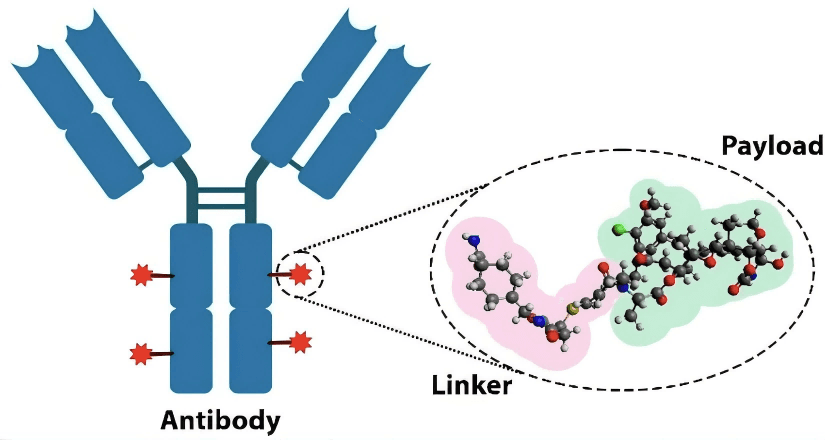
In the realm of precision oncology, antibody-drug conjugates (ADCs) have emerged as a revolutionary "magic bullet," channeling the visionary concept proposed over a century ago by Paul Ehrlich. By fusing monoclonal antibodies with potent cytotoxic payloads, ADCs aim to deliver targeted strikes against cancer cells while sparing healthy tissues, addressing the shortcomings of traditional chemotherapy. A recent comprehensive review published in ChemMedChem delves into the pivotal role of linkers—the molecular bridges connecting antibodies and payloads—in optimizing ADC performance.[1]
The Backbone of ADC Success: Understanding Linkers
ADCs consist of three core components: the antibody for tumor-specific targeting, the cytotoxic payload for cell destruction, and the linker that ensures stability during circulation and precise release at the tumor site. Linkers are the "soul" of ADC design, directly influencing pharmacokinetics, efficacy, and safety. Poor linker design can lead to premature payload release in the bloodstream, causing systemic toxicity, or insufficient release in tumors, reducing therapeutic impact.
To date, 17 ADCs have gained regulatory approval worldwide for treating hematologic malignancies and solid tumors, such as breast, lung, and ovarian cancers. The authors systematically analyze the linkers in these approved therapies, categorizing them into cleavable and non-cleavable types. Cleavable linkers, responsive to tumor-specific stimuli like low pH, enzymes (e.g., cathepsin B), or reducing environments (e.g., glutathione), dominate in most approved ADCs for their ability to facilitate controlled payload delivery. Non-cleavable linkers, reliant on lysosomal degradation of the entire conjugate, offer greater plasma stability but may limit payload potency due to residual linker fragments.[2]
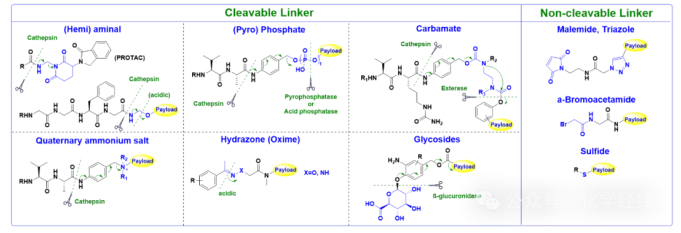
Various Commonly Used Linker Fragments
Key Strategies in Linker Construction
The review outlines established strategies for linker assembly, emphasizing three functional modules: bioconjugation groups for antibody attachment (e.g., maleimide or succinimide-based), drug release triggers for site-specific activation, and spacer units to modulate hydrophilicity and prevent aggregation. For instance, valine-citrulline (Val-Cit) dipeptide linkers, enzyme-cleavable and used in drugs like brentuximab vedotin, exemplify how tailored triggers enhance selectivity.
Innovations in bioconjugation have shifted toward site-specific methods, such as enzyme-mediated (e.g., transglutaminase) or unnatural amino acid incorporation, to achieve homogeneous drug-to-antibody ratios (DAR). This reduces variability compared to traditional lysine or cysteine conjugation, improving consistency and therapeutic windows.
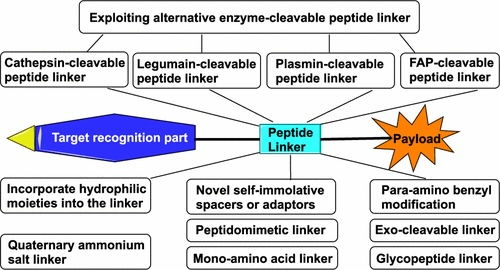 Exploiting Alternative Enzyme-Cleavable Peptide Linkers in ADC Design
Frontier Advances: Pushing the Boundaries of Innovation
Over the past decade, linker technology has evolved dramatically. Key breakthroughs include:
1. Advanced Drug Release Triggers: Novel mechanisms like dual-cleavable systems (combining pH and enzyme sensitivity) and bioorthogonal activations enable ultra-precise payload release, minimizing off-target effects.
2. Hydrophilic Spacers and Traceless Release: Incorporating polyethylene glycol (PEG) or charged groups improves solubility, while traceless designs ensure the payload is released in its native, unmodified form for maximum potency.
3. Branched and Multifunctional Architectures: Branched linkers allow higher DAR without compromising stability, amplifying cytotoxicity. Additionally, the "bystander effect"—where released payloads diffuse to kill neighboring antigen-negative cells—has been optimized through permeable linkers, expanding efficacy against heterogeneous tumors.
4. AI-Driven Optimization: Emerging tools like machine learning models (e.g., Linker-GPT) are accelerating linker discovery by predicting synthetic feasibility and drug-likeness.[3]
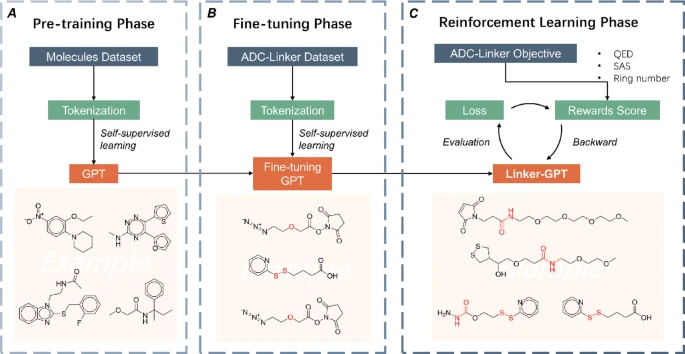
Workflow of molecular generator, including pre-training(A), fine-tuning(B), and RL(C).
These advances have not only enhanced ADC profiles but also paved the way for applications beyond oncology, such as in autoimmune diseases.
Challenges and Future Horizons
Despite advancements, challenges remain, including linker-induced immunogenicity, manufacturing scalability, and tumor resistance mechanisms. Interdisciplinary approaches, integrating computational modeling, nanotechnology, and biomarker-driven selection, are crucial to surmount these obstacles.
Looking forward, the rational design of next-generation ADCs holds promise for broader clinical impact. By refining linker strategies, researchers can develop more effective and safer therapies, potentially revolutionizing cancer treatment paradigms.
This area offers essential resources for scientists and clinicians, providing practical insights into linker advancements and their implications for future drug development.
Read More
1. https://chemistry-europe.onlinelibrary.wiley.com/doi/10.1002/cmdc.202500262
2. https://pubmed.ncbi.nlm.nih.gov/40432256/
3. https://www.nature.com/articles/s41598-025-05555-3