
What the Nature Chemical Biology paper actually supports
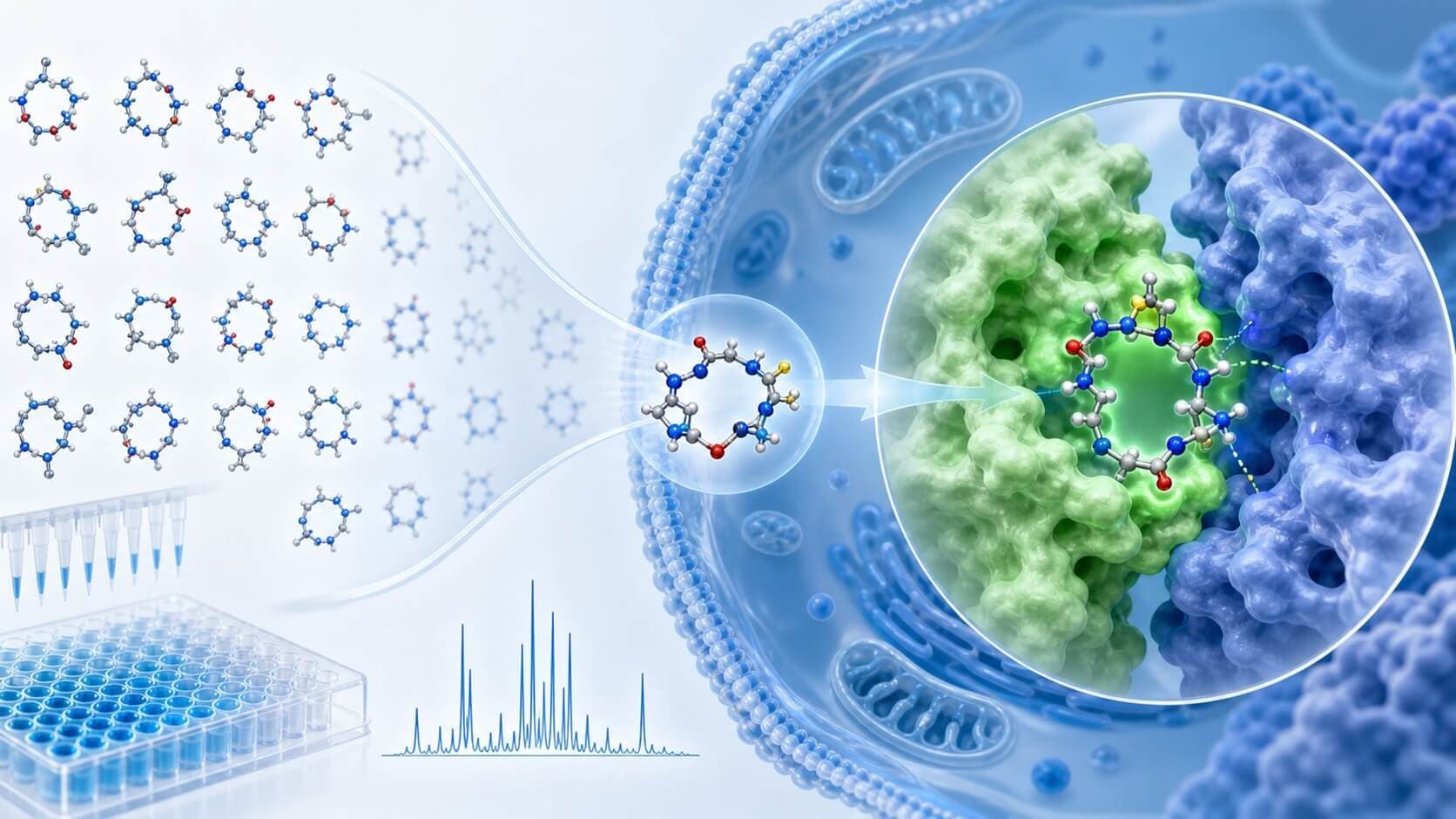
The Nature Chemical Biology paper reports a de novo cyclic-peptide screening strategy for intracellular protein-protein interaction targets. The authors screened 15,360 fully random cyclic peptides and identified inhibitors of the Keap1/Nrf2 interaction, then used rapid design-build-test cycles to produce a membrane-permeable compound active in live cells.
That primary paper is strong enough to support a technical article on library design, intracellular screening, cyclic-peptide permeability, and hit optimization. It does not need to be treated as a clinical or product-status story, and it should not be extended into therapeutic efficacy claims.
Why the library design matters to peptide chemistry teams
The reported library uses small, nonpolar cyclic peptides to address a hard discovery problem: PPIs often present broad and polar surfaces, while peptides that bind such targets frequently struggle to cross membranes. Restricting the library toward uncharged residues and cyclic topologies creates a search space where binding and permeability can be evaluated together.
For synthesis teams, the important detail is scale and diversity. A 15,360-member library requires reproducible small-scale assembly, robust quality control logic, and screening-compatible material handling. Even when each member is produced at nanomole scale, chemistry variation can affect hit interpretation if failed syntheses, truncations, or purification artifacts are not understood.
Screening logic connects discovery to developability
The paper frames screening as a functional route to PPI inhibitors rather than as a structure-first exercise. That matters because a hit emerging from a cellular or intracellular readout already carries some information about permeability and target engagement context. The follow-up development question is whether the cyclic peptide can retain activity while improving synthesis, stability, and physicochemical properties.
This is where chemistry becomes decisive. Linker selection, ring size, residue substitution, N-methylation or other backbone changes, and purification behavior can all change the balance between potency, permeability, and manufacturability. A discovery hit is therefore a starting point for iterative chemical optimization, not a final development molecule.
What to evaluate after a cyclic-peptide hit
- Confirm the cyclic structure and distinguish it from linear or partially cyclized material.
- Map substitutions that preserve target activity while improving synthesis and purification.
- Track permeability-related physicochemical properties without assuming one rule fits all macrocycles.
- Assess whether any covalent or reactive design element creates additional impurity or stability questions.
- Connect hit-to-lead chemistry with a realistic route for milligram-to-gram material supply.
References
Primary paper: https://doi.org/10.1038/s41589-026-02237-7
FAQ
Is this article about a clinical candidate?
No. It discusses a peer-reviewed discovery method and its chemistry implications for cyclic-peptide libraries and intracellular PPI inhibitor discovery.
Why is the 15,360-member count included?
The count appears in the Nature Chemical Biology abstract and defines the library scale that drives the article’s synthesis and quality-control discussion.
What is the CHEMOS-relevant angle?
The article focuses on cyclic-peptide library synthesis, cyclization, structural confirmation, permeability-aware optimization, and hit-to-lead material supply.