
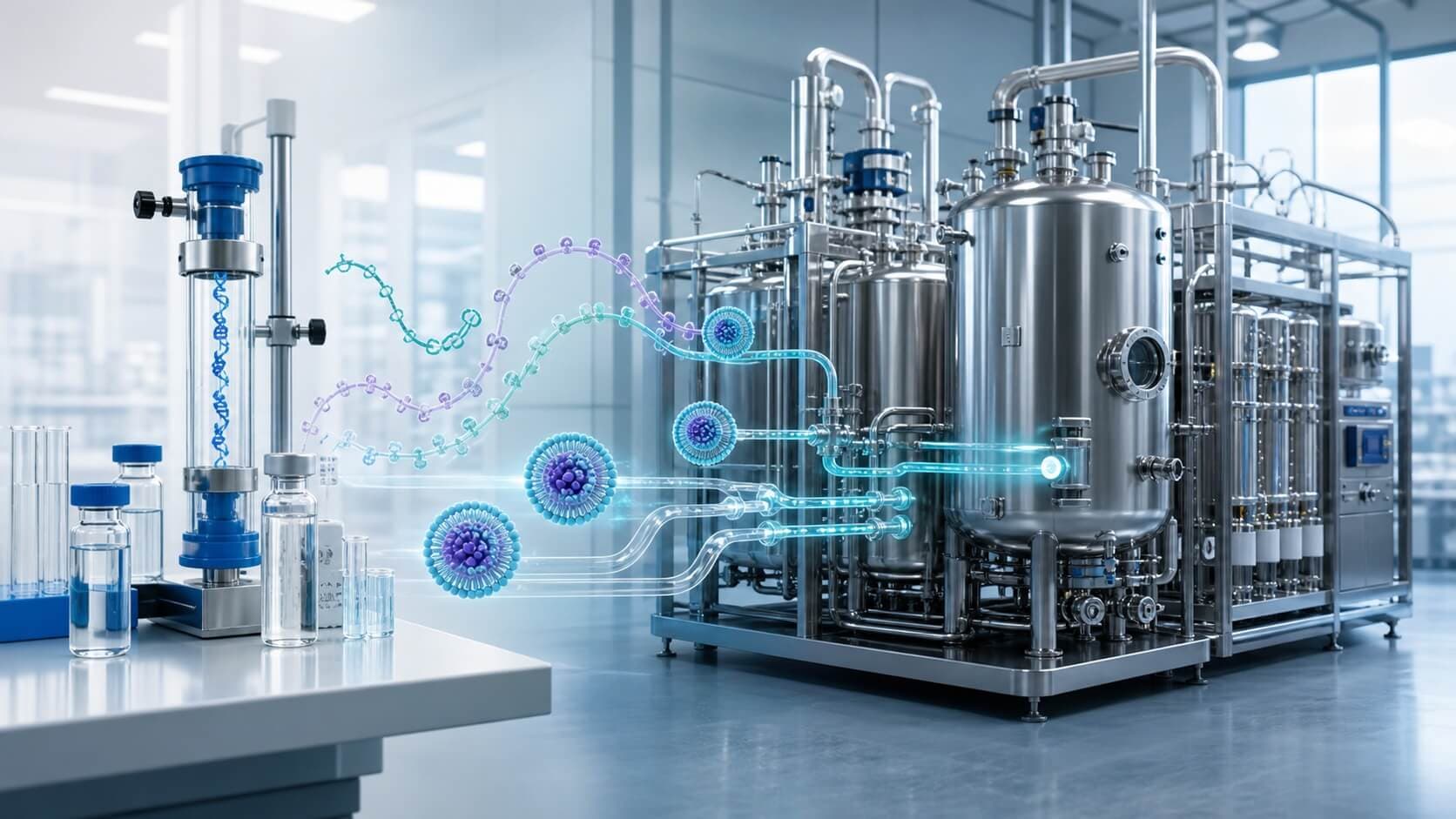
Why Scale-Up Is Not a Linear Process
Scale-up is not simply a matter of making the same process larger. In oligonucleotide synthesis, purification and LNP formulation, process behavior can change when equipment size, batch volume, flow path, mixing time or heat and mass transfer changes. A condition that works in a small research batch may not produce the same impurity profile or physical quality at larger scale.
For companies developing siRNA-related programs, scale-up risk should be considered early. Route choices, reagent quality, purification strategy, analytical methods and delivery platform all influence whether a process can move from milligram or gram quantities to larger development batches.
Scale-up discussions should start with a realistic definition of scale. A gram-scale research batch, a hundred-gram intermediate batch and a kilogram supply campaign may all require different route decisions. For CHEMOS customers, the relevant question is often not full drug-product manufacturing. It is whether a complex lipid, linker, GalNAc building block or specialty intermediate can be made reproducibly at the next useful scale.
Solid-Phase Synthesis Scale-Up
Solid-phase oligonucleotide synthesis depends on efficient contact between reagents and the growing chain on the solid support. At larger scale, column geometry, flow distribution, pressure drop and reagent penetration can affect coupling efficiency. Uneven reagent distribution may create local differences in full-length product formation.
Reagent consumption is another issue. Oligonucleotide synthesis uses excess phosphoramidites, activators, solvents and wash solutions. Modified monomers and ligand-containing building blocks can be expensive. A scale-up process must balance coupling efficiency with reagent cost.
Water control, solvent quality and reagent stability become more important at larger scale. Small moisture differences can reduce coupling efficiency. Longer processing times may increase exposure to degradation conditions.
| Scale-up factor | Why it changes with scale | Development response |
|---|---|---|
| Reagent distribution | Larger beds or vessels can create uneven contact | Evaluate flow path, mixing and residence time |
| Moisture exposure | Longer handling times increase risk | Improve solvent drying, packaging and transfer controls |
| Heat transfer | Larger volumes may show temperature gradients | Monitor temperature and avoid over-harsh conditions |
| Purification loading | Higher load may reduce resolution | Define purity-yield trade-off experimentally |
| Waste volume | Solvent and buffer volumes increase quickly | Consider process economics and waste handling early |
| Batch documentation | Reproducibility becomes more important | Standardize release tests and impurity tracking |
Cleavage and Deprotection Scale-Up
After synthesis, the oligonucleotide must be cleaved from the support and deprotected. At small scale, these operations may be straightforward. At larger scale, mixing, temperature uniformity, reaction time and material compatibility become more important.
Incomplete deprotection can leave product-related impurities. Harsh conditions can increase degradation. RNA and heavily modified sequences may require careful condition selection. The process must remove protecting groups without damaging sensitive motifs.
Purification Scale-Up
Purification is often a major bottleneck. At analytical or small preparative scale, separation may look clean. At larger scale, column loading, flow rate, gradient slope and resin performance can reduce resolution. A near-baseline separation at small scale may become a shoulder or overlapping peak during production.
Ion-exchange chromatography can be useful for length-related impurities, but high salt volumes must be managed. Reverse-phase methods can provide high resolution but may require large volumes of organic solvent and ion-pairing reagents. TFF is important for desalting and concentration but must be optimized to avoid product loss and membrane fouling.
Economic trade-offs are unavoidable. Higher purity may reduce yield. Lower loading may improve resolution but reduce productivity. More purification steps may improve quality but increase cost and cycle time.
LNP Formulation Scale-Up
LNP scale-up is a mixing and particle-formation challenge. Particle assembly occurs during rapid mixing of lipid-containing organic phase with nucleic-acid-containing aqueous phase. Parameters such as flow rate ratio, total flow rate, solvent composition, pH and temperature can influence particle size, PDI and encapsulation.
When scaling up, increasing channel dimensions may change mixing time and particle formation behavior. Numbering-up, where multiple small mixing units run in parallel, can preserve mixing conditions better than simply enlarging a single channel.
Downstream steps such as buffer exchange, concentration, sterile filtration and filling can also affect particle quality. LNPs may be sensitive to shear, concentration changes, temperature and freeze-thaw history.
For LNP-related material suppliers, the scale-up connection is indirect but important. If an ionizable lipid is made by a route that changes impurity profile at larger scale, the LNP formulation may change even if the nominal lipid structure is the same. If a PEG-lipid contains different chain-length distribution or degradation products between batches, particle-size control may shift. Reliable LNP scale-up therefore begins upstream, with reproducible lipid and excipient-related chemistry.
Batch Consistency and Process Control
Batch consistency depends on identifying critical process parameters and critical material attributes. For oligonucleotide synthesis, important parameters may include coupling time, monomer concentration, activator quality, detritylation conditions, sulfurization conditions and support loading. For LNPs, important parameters may include lipid quality, molar ratio, mixing conditions, buffer composition and post-formulation processing.
Process analytical technology can support better control. DMT monitoring can help track coupling efficiency. At-line or online particle-size measurement can support LNP formulation development. LC-MS and HPLC can provide rapid impurity feedback. The goal is to move from reactive troubleshooting to knowledge-based process control.
QbD and Development Strategy
Quality by Design encourages teams to understand how material attributes and process parameters affect quality outcomes. In practice, this means using risk assessment, design of experiments and structured control strategies.
For oligonucleotide and LNP-related projects, QbD thinking can help prioritize development work. Not every parameter needs the same level of study. The most important parameters are those that affect identity, purity, impurity profile, particle attributes, stability and downstream performance.
A simple QbD-style review for a custom material can ask:
| Question | Why it matters |
|---|---|
| Which impurities are most likely from the route? | Directs analytical method development |
| Which impurities are hardest to remove? | Guides purification strategy and specification setting |
| Which material attributes affect downstream use? | Prevents over-testing irrelevant attributes and under-testing important ones |
| Which parameters are sensitive during scale-up? | Identifies where engineering controls are needed |
| What changes require customer notification? | Supports batch comparability and trust |
How CHEMOS Supports Scale-Up-Oriented Projects
CHEMOS supports custom synthesis, route development, process optimization and analytical support for complex pharmaceutical intermediates, LNP-related lipids, GalNAc-related building blocks, PEG spacers, linkers and functional materials. For scale-up-oriented projects, CHEMOS can review route feasibility, raw material access, impurity risks, purification strategy, batch size and documentation requirements.
The practical value of a synthesis partner is not only delivering a first sample. It is helping customers move toward reproducible material supply with a realistic process and clear analytical understanding.
FAQ
Why does oligonucleotide scale-up create new problems?
Larger equipment changes flow distribution, reagent contact, pressure, mixing and purification behavior. These changes can affect yield and impurity profiles.
What is the main scale-up risk for LNPs?
Maintaining equivalent mixing and particle formation behavior is one of the main challenges.
How can scale-up risk be reduced?
Early route evaluation, impurity understanding, process parameter control, orthogonal analytics and QbD-style development can reduce risk.
References and Further Reading
- ICH Q11. Development and Manufacture of Drug Substances. https://www.ich.org/page/quality-guidelines
- ICH Q8(R2). Pharmaceutical Development. https://www.ich.org/page/quality-guidelines
- ICH Q9(R1). Quality Risk Management. https://www.ich.org/page/quality-guidelines
- ICH Q13. Continuous Manufacturing of Drug Substances and Drug Products. https://www.ich.org/page/quality-guidelines
- Inguva PK, et al. Mechanistic Modeling of Lipid Nanoparticle Formation for the Delivery of Nucleic Acid Therapeutics, 2024. https://arxiv.org/abs/2408.08577
- Hou X, Zaks T, Langer R, Dong Y. Lipid nanoparticles for mRNA delivery. Nature Reviews Materials, 2021. https://doi.org/10.1038/s41578-021-00358-0