
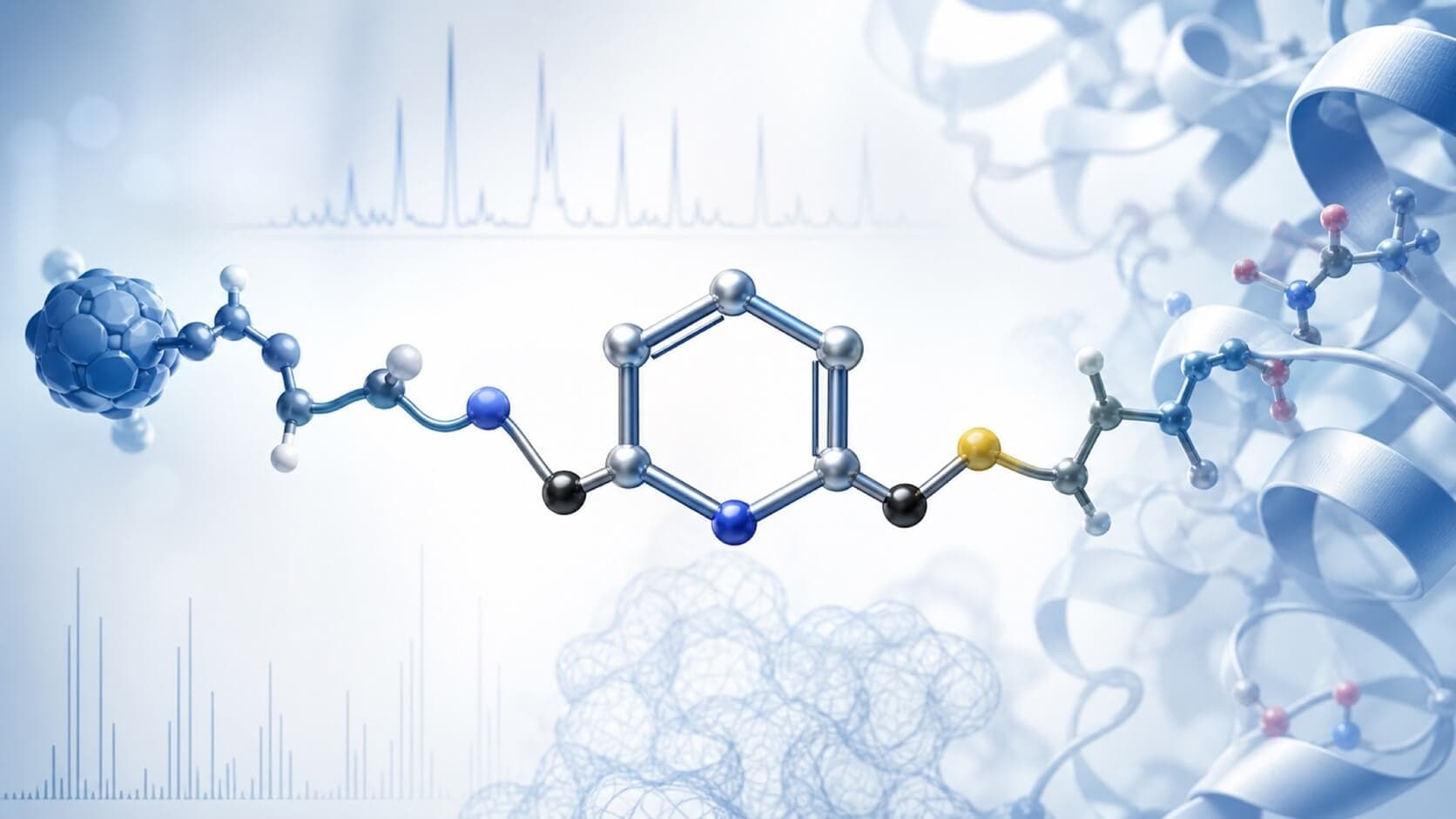
The pyridine reagent programs amine coupling before cysteine capture
The platform uses two differentiated leaving groups on one pyridine ring. In the first operation, a primary amine replaces fluorine through nucleophilic aromatic substitution (SNAr), installing an amine-bearing linker, payload, PEG chain, or other functional unit while the thianthrenium group remains in place. In the second operation, a cysteine thiol displaces thianthrenium to create the aryl-sulfur connection.
This sequence makes reaction order part of the reagent design. It separates functional-unit installation from biomolecule capture and produces a cysteine S-aryl bond rather than the succinimide thioether formed by maleimide addition. For ADC and other bioconjugation teams, the practical question is whether that programmed sequence can deliver reproducible conversion, species distribution, and bond stability on the intended substrate.
The bond architecture addresses two maleimide liabilities
Maleimide-cysteine conjugation is widely used because thiol addition is operationally accessible, but the resulting succinimide thioether can undergo retro-Michael chemistry and thiol exchange. The addition is also non-stereoselective, so conjugated material can contain a diastereomeric mixture.
The pyridine route changes the underlying connection. Cysteine sulfur becomes bonded directly to an aromatic carbon, so the product does not contain the same Michael adduct or succinimide ring. The reported work characterizes this S-aryl linkage as irreversible and resistant to thiol exchange. That structural rationale is relevant to linker design, but performance still has to be established for each complete conjugate, formulation, and storage condition.
Chemoselectivity and site selectivity require separate checks
The two leaving groups must remain differentiated across both operations. Thianthrenium has to tolerate the amine SNAr step, then depart efficiently when the cysteine-containing substrate is introduced. Competition experiments were reported to give greater than 99% cysteine selectivity in peptides containing Lys, His, Ser, and Tyr residues.
Residue selectivity is not automatically site selectivity. A reagent that distinguishes thiols from amines and alcohols may still react with more than one accessible cysteine in a protein. Development teams therefore need to map the modified residue or residues, quantify unmodified and multiply modified species, and determine whether substrate conformation or reduction state changes the distribution.
The reported substrate scope included aromatic, aliphatic, and PEG-containing primary amines, together with cysteine peptides and proteins such as BSA, lysozyme, and trastuzumab. Reactions were described under mild aqueous conditions, including pH 7.4 and 37 °C. These examples establish a feasibility range, not a universal process window.
Process development should treat the two reactions as distinct unit operations
A sequential platform creates more control points than a single-step maleimide addition. A practical development plan should separate them:
- Pyridine reagent control: define identity, assay, water content, counterion state, residual precursors, and storage stability for the thianthrenium reagent.
- Amine-installation control: establish substrate-specific stoichiometry, solvent or buffer composition, temperature, conversion endpoint, and clearance of unreacted amine-bearing material.
- Cysteine-capture control: evaluate thiol availability, pH, reagent excess, mixing, reaction time, and the effect of competing low-molecular-weight thiols.
- Isolation and hold-time control: define quench conditions, removal of small-molecule by-products, intermediate hold limits, and recovery through concentration or purification.
- Scale-up assessment: measure mass balance and impurity behavior while examining the synthesis cost and availability of the thianthrenium reagent rather than assuming scale readiness.
This separation also helps diagnose failure. Low overall conjugation can arise from an incomplete first SNAr, loss or decomposition of the thianthrenium-bearing intermediate, inaccessible cysteine, or losses during downstream purification. One final conversion value cannot distinguish those causes.
An analytical package should connect bond identity to product distribution
Reported antibody-conjugate work included HIC, SEC, and serum-stability comparisons. Those assay categories are relevant to development, but they do not establish clinical performance or universal platform superiority.
For a new construct, an analytical plan can include:
- intact or subunit mass analysis to confirm the expected mass shift;
- peptide mapping to locate the S-aryl modification and measure site occupancy;
- HIC or another suitable separation to examine conjugate-species distribution;
- SEC to track aggregate and fragment levels;
- targeted assays for residual reagent, leaving-group-derived species, and unreacted functional unit; and
- time-course testing under formulation, thiol-challenge, and storage conditions to distinguish chemical deconjugation from protein degradation.
The central comparison is not simply whether coupling occurs. It is whether the selected route produces a defined bond, a controlled distribution, and a stability profile that remains interpretable after purification and storage.
A staged evaluation keeps the platform claim proportional to the data
An efficient screening sequence begins with a small-molecule amine and a simple cysteine model, then advances to the project-specific peptide or protein. At each stage, teams can set acceptance criteria for conversion, selectivity, recovery, and impurity clearance before increasing molecular complexity.
Only after those chemistry and analytical checkpoints are met does an antibody-level comparison become informative. The published concept supports evaluation of a maleimide alternative; it does not by itself establish manufacturing robustness, economic viability, or suitability for every cysteine-containing target.
Frequently asked questions
What makes the pyridine reagent a non-equivalent dielectrophile?
It carries two electrophilic positions with different leaving groups and different reaction timing. Fluorine is displaced by an amine during the first SNAr step, while thianthrenium is retained until displacement by a cysteine thiol.
Why use an S-aryl cysteine linkage?
The aryl-sulfur bond avoids the succinimide-thioether architecture responsible for the retro-Michael pathway in maleimide conjugates. The reported platform was designed to use that bond difference while retaining chemoselective cysteine capture.
Does greater than 99% cysteine selectivity guarantee one modification site?
No. The reported competition result distinguishes cysteine from other nucleophilic residue types. A protein with multiple accessible cysteines still requires site-occupancy and species-distribution analysis.
Is the platform ready to replace maleimide at manufacturing scale?
Not on the reported feasibility evidence alone. Reagent synthesis, cost, stability, reaction robustness, purification, analytical control, and substrate-specific performance all require project-level assessment.
Reference
Dang X, Zhang C, Shang J, et al. “Modular Assembly of Bioconjugates Enabled by a Pyridine-Based Chemoselective Sequential Conjugation Platform.” Angewandte Chemie International Edition. Published July 8, 2026. https://doi.org/10.1002/anie.3286230