
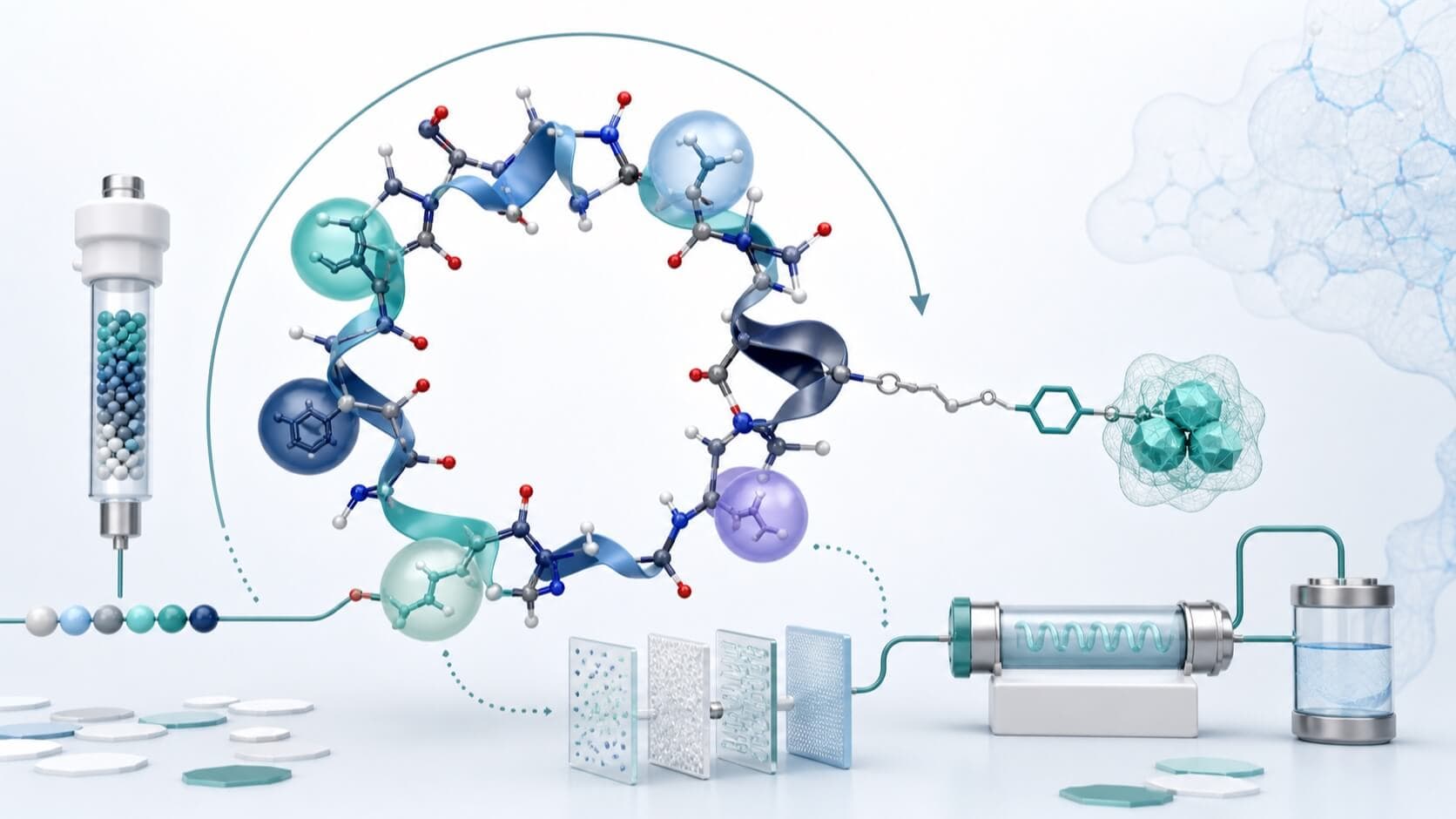
In brief: cyclic peptides require integrated chemistry and process control
Cyclic-peptide development is not a single ring-closing problem. It requires coordinated choices in amino-acid building blocks, cyclization, conformation, purification, formulation, and, where relevant, linker-payload conjugation so that a promising sequence can become a reproducible process.
The design space is broad, but not evenly distributed
In the review's CAS-derived set of 46,574 therapeutic cyclic-peptide samples from 2020–2025, macrocycles containing at least six amino acids formed the largest group, with 25,254 samples. Bicyclic or multicyclic structures accounted for 10,020, while tetra- and pentapeptides accounted for 7,312 and 3,334. Di- and tripeptides were rare, consistent with the ring strain associated with very small cycles.
Cyclization choices were similarly concentrated. The review reports head-to-tail closure as 65% of the sample set, or 32,255 structures, followed by 11,884 side-to-tail examples. Mixed, head-to-side, and side-to-side approaches occupied smaller parts of the dataset. These counts describe research activity rather than a universal route-selection rule, but they show where process experience is accumulating.
Modification patterns reveal a second layer of design. The review counts 10,563 N-methylated examples, 5,519 structures containing disulfides, and 4,054 containing thioethers. N-methylation can reduce exposed hydrogen-bond donors and support membrane-permeability strategies. Disulfide and thioether bridges offer different stability profiles, while lipidation, PEGylation, and glycosylation can be used to adjust delivery, half-life, or solubility. Each choice also changes raw-material requirements, reaction selectivity, impurity profiles, and analytical methods.
Oral delivery remains a chemistry problem
The attraction of an oral cyclic peptide is easy to understand; the physicochemical constraints are harder. The review reports that more than 96% of the analyzed structures exceed 500 Da, 99% have a polar surface area above 140 Ų, and 82% contain more than ten rotatable bonds. Most therefore sit outside several classical small-molecule guidelines. Approved and clinical-stage examples in the review nevertheless cluster within narrower property space—molecular weights of 1,000–2,500 Da and Log P values of 0–5—showing that useful behavior cannot be inferred from molecular weight alone.
The reported obstacles include oral bioavailability commonly below 1%, rapid renal clearance for some larger molecules, reduction-sensitive linkages such as disulfides, and formulation difficulties caused by poor solubility. These are class-level development challenges, not predictions for any individual candidate.
Design responses operate at several levels. N-methylated residues can cap amide hydrogen-bond donors; D- and other non-natural amino acids can improve resistance to intestinal proteases; and conformational designs can create intramolecular hydrogen bonds that mask polarity in a membrane environment. Lipid systems, permeation enhancers, enteric coatings, and polymer nanoparticles add formulation options. Ingestible microneedle devices are also under development for macromolecule delivery, but they should be viewed as device-led approaches rather than evidence that conventional intestinal absorption has been solved.
Scale-up begins with the ring-closing step
Macrocyclization must favor the intended intramolecular reaction while limiting oligomerization and other competing pathways. The review highlights click reactions, enzyme-mediated cyclization, and transition-metal-mediated closure as routes toward milder or more selective processing. Automated solid-phase peptide synthesis, flow chemistry, and enzyme-catalyzed production are identified as manufacturing directions.
For process teams, those labels are only a starting point. A scalable route must combine selective ring closure with reproducible synthesis, purification, and analytical control. Closing the ring at laboratory scale is not enough if oligomeric or closely related cyclic species cannot be separated and characterized consistently.
The same principle applies to conjugated modalities. The review discusses peptide–drug conjugates, bispecific cyclic peptides, PROTAC designs, and imaging or theranostic conjugates. Zelenectide pevedotin, formerly BT8009, illustrates the additional architecture of a Nectin-4-targeting bicyclic peptide, a cleavable valine-citrulline linker, and an MMAE payload. Bicycle Therapeutics lists the program in randomized Phase II development. This status does not establish a class-wide safety or efficacy advantage; it does show how peptide synthesis and linker-payload chemistry meet in a single development package.
What the trend means for chemistry teams
The review reports 23,471 cyclic-peptide papers and patents from 2006–2025, comprising 15,429 journal articles and 8,042 patents. It also records a rise in activity from 2015 and a 2021–2024 peak. Oncology represented the largest therapeutic group in its 2020–2025 dataset, followed by infectious disease, inflammation, and autoimmune applications.
For CHEMOS readers, the durable signal is a growing need for integrated peptide chemistry: N-methylated and non-natural amino-acid building blocks, reproducible cyclization, bridge and linker control, conjugation chemistry, and analytical methods able to distinguish closely related cyclic and oligomeric species. Screening technologies may expand the number of candidate sequences, but manufacturability still depends on what can be synthesized, purified, characterized, and transferred to a robust process.
Frequently asked questions
What makes cyclic peptides difficult to manufacture at scale?
The ring-closing step must favor the intended intramolecular reaction while limiting oligomerization and other competing pathways. Scale-up also requires reproducible synthesis, purification, and analytical characterization of closely related cyclic species.
Why are N-methylated and non-natural amino acids used in cyclic peptides?
N-methylation can reduce exposed hydrogen-bond donors and support membrane-permeability strategies. D-amino acids and other non-natural residues can improve resistance to intestinal proteases, although neither modification alone guarantees oral exposure.
Which cyclization technologies does the review highlight?
The review identifies click reactions, enzyme-mediated cyclization, and transition-metal-mediated ring closure as advanced approaches, alongside automated solid-phase peptide synthesis, flow chemistry, and enzyme-catalyzed production as manufacturing directions.
How do cyclic peptides connect with peptide-drug conjugates?
Cyclic peptides can provide the targeting component of a conjugate that also includes a linker and payload. Zelenectide pevedotin illustrates this architecture with a Nectin-4-targeting bicyclic peptide, a cleavable valine-citrulline linker, and an MMAE payload.
Reference
- Qiongqiong Angela Zhou and co-authors, “Cyclic Peptides in Modern Drug Discovery: Trends and Therapeutic Directions,” Journal of Medicinal Chemistry, published online August 13, 2026. https://doi.org/10.1021/acs.jmedchem.6c01522