
SOPC
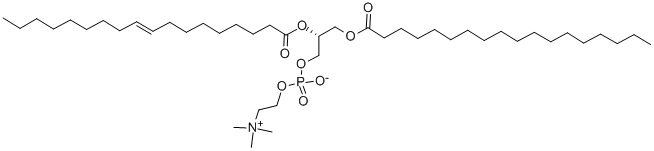
1-stearoyl-2-oleoyl-sn-glycero-3-phosphocholine
Résumé du produit
Aperçu rapide
- Famille de produits
- LNP & Nucleic Acid Delivery Lipids
- Nom chimique
- 1-stearoyl-2-oleoyl-sn-glycero-3-phosphocholine
- FM
- C44H86NO8P
- PM
- 788.1
SOPC refers here to 1-stearoyl-2-oleoyl-sn-glycero-3-phosphocholine, also represented as PC(18:0/18:1(9Z)).
This record matches CAS 56421-10-4, molecular formula C44H86NO8P, molecular weight about 788.1, and PubChem CID 24778825.
SOPC is paired with the full name and PC(18:0/18:1(9Z)) notation to distinguish the intended cis-oleoyl identity from related CAS-linked records.
Identité et spécifications
| Catalog No. | CH51056 |
| CAS No. | 56421-10-4 |
| Chemical Name | 1-stearoyl-2-oleoyl-sn-glycero-3-phosphocholine |
| Molecular Formula | C44H86NO8P |
| Molecular Weight | 788.1 |
| PubChem CID | 24778825 |
Contexte d’application
- SOPC identity reference: supports matching SOPC, PC(18:0/18:1(9Z)), CAS 56421-10-4, and PubChem CID 24778825.
- Bilayer and vesicle research: supporting references include SOPC literature in bilayer, vesicle, and membrane-biophysics studies.
- Representation control: useful where the intended cis-oleoyl SOPC identity must be kept separate from related CAS-linked records.
Informations complémentaires sur le matériau
Utilisations
Use this page to align SOPC, PC(18:0/18:1(9Z)), CAS 56421-10-4, and PubChem CID 24778825 before comparing product records or literature references.
Caractéristiques
- Phosphatidylcholine identity with one stearoyl chain and one oleoyl chain.
- The intended oleoyl chain is represented as 18:1(9Z) in the source PubChem anchor.
- CAS lookup can return related stereochemical or geometric records, so exact-name matching is important.
Ressources techniques associées
Matériaux lipidiques pour vectorisation
Analogues de lipides ionisables, PEG-lipides, phospholipides, stérols et conjugués ligand-lipide pour la recherche.
Design de lipides ionisables
Définir les analogues par structure exacte, rôle de formulation, charge utile, voie expérimentale, hypothèse de dégradation et contrôles matière.
Sources publiques
- 1-Stearoyl-2-oleoyl-sn-glycero-3-phosphocholine | PubChem CID 24778825
- High-throughput in vivo screen of functional mRNA delivery identifies nanoparticles for endothelial cell gene editing
PNAS, 2018
Product-family technical context
- Selective organ targeting nanoparticles for tissue-specific mRNA delivery and CRISPR-Cas gene editing
Nature Nanotechnology, 2020
Product-family technical context
- Rational Design of Cationic Lipids for siRNA Delivery
Nature Biotechnology, 2010
Product-family technical context
- Biodegradable Lipids Enabling Rapidly Eliminated Lipid Nanoparticles for Systemic Delivery of RNAi Therapeutics
Molecular Therapy, 2013
Product-family technical context
Questions fréquentes
Why keep the full name with SOPC?
The full name and PC(18:0/18:1(9Z)) notation keep the page tied to the intended cis-oleoyl SOPC identity.
Produits similaires


Besoin d’aide pour sélectionner un matériau ?
CHEMOS peut examiner l’adéquation produit, la structure cible, les questions de voie, les attentes analytiques et les besoins d’approvisionnement du projet.