
GalNAc-L96-Succinate, Triethylammonium Salt
Oligonucleotide Conjugation & Delivery Ligands
Résumé du produit
Aperçu rapide
- Famille de produits
- Oligonucleotide Conjugation & Delivery Ligands
- FM
- C127H194N12O45
- PM
- 2608.9
- Pureté
- >=98% (HPLC)
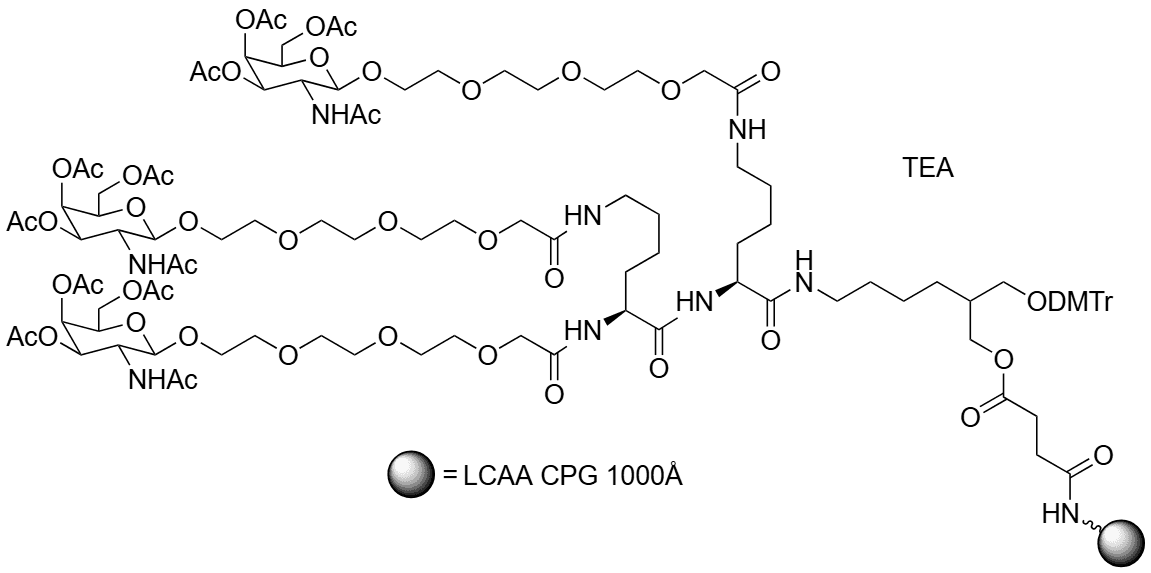
GalNAc-L96-Succinate, Triethylammonium Salt is a conjugate support-loading precursor for oligonucleotide synthesis: a triantennary (trivalent) N-acetylgalactosamine ("GalNAc", L96) cluster joined to a succinate half-ester, supplied as its triethylammonium salt. Key identifiers include CAS 1159408-62-4, molecular formula C127H194N12O45, and molecular weight 2608.9 (PubChem CID 168006875).
Unlike a phosphoramidite, this reagent carries a 3'-O-succinate half-ester rather than a coupling group. The succinate is the conventional linker for attaching a 3'-terminal unit — here the GalNAc cluster — to an amino-functionalized solid support, so the oligonucleotide is then assembled carrying the GalNAc ligand at its 3'-end. The succinyl linkage is base-cleavable and is broken during deprotection to release the finished conjugate. Triantennary GalNAc binds the asialoglycoprotein receptor (ASGPR), a lectin on the surface of hepatocytes.
Synonymes
triantennary GalNAc (L96) succinate, TEA salt; trivalent N-acetylgalactosamine cluster support-loading succinate
Identité et spécifications
| Catalog No. | CH67002 |
| CAS No. | 1159408-62-4 |
| Molecular Formula | C127H194N12O45 (triethylammonium salt) |
| Molecular Weight | 2608.9 |
| PubChem CID | 168006875 |
| InChIKey | IJXFTQRCIYIYHZ-MCDRDKEWSA-N |
| Purity | >=98% (HPLC) |
Conditions de stockage
-20 +/- 5 C
Caractéristiques techniques
- Ligand format
- Triantennary GalNAc cluster
- Linker scaffold
- L96
- Functional terminus
- 3'-O-Succinate
- Counterion form
- Triethylammonium salt
- Packaging
- 10 mg; 50 mg; Custom packaging on request
- Physical form
- solid
- Stability
- >=4 years
Contexte d’application
- GalNAc-L96-Succinate, Triethylammonium Salt reference: use this GalNAc support-linker building block record for oligonucleotide conjugation and delivery-ligand catalog work.
- Identifier cross-check: compare CAS 1159408-62-4, PubChem CID 168006875, formula C127H194N12O45 (triethylammonium salt), MW 2608.9, and the listed InChIKey for catalog identity matching.
- Inquiry preparation: include catalog number CH67002, the product name, and the identity-matching identifiers when preparing a CHEMOS product inquiry.
Ressources techniques associées
Sources publiques
- Targeted delivery of antisense oligonucleotides to hepatocytes using triantennary N-acetyl galactosamine improves potency in mice
Nucleic Acids Research, 2014
Product-family technical context
- Multivalent N-acetylgalactosamine-conjugated siRNA localizes in hepatocytes and elicits RNAi-mediated gene silencing
Journal of the American Chemical Society, 2014
Product-family technical context
- siRNA Conjugates Carrying Sequentially Assembled Trivalent N-Acetylgalactosamine Linked Through Nucleosides Elicit Robust Gene Silencing In Vivo in Hepatocytes
ACS Chemical Biology, 2015
Product-family technical context
- Comparative Characterization of Hepatic Distribution and mRNA Reduction of Antisense Oligonucleotides Conjugated with Triantennary N-Acetyl Galactosamine and Lipophilic Ligands
Journal of Pharmacology and Experimental Therapeutics, 2016
Product-family technical context
- Composé PubChem 168006875
PubChem · CID 168006875
Questions fréquentes
Is this a phosphoramidite?
No. It is a GalNAc-cluster 3'-O-succinate (a conjugate support-loading precursor), not a phosphoramidite. Its succinate half-ester attaches the triantennary GalNAc ligand to a solid support so the oligonucleotide is built carrying the GalNAc at its 3'-end.
What is a triantennary GalNAc cluster, and what does it bind?
It is a trivalent presentation of N-acetylgalactosamine (three GalNAc sugars on a branched scaffold). Triantennary GalNAc binds the asialoglycoprotein receptor (ASGPR), a lectin on the surface of hepatocytes.
Produits similaires
Besoin d’aide pour sélectionner un matériau ?
CHEMOS peut examiner l’adéquation produit, la structure cible, les questions de voie, les attentes analytiques et les besoins d’approvisionnement du projet.