
Why alternative enzymatic triggers matter for linker design
Many established ADCs with cleavable linkers rely on cathepsin B, a lysosomal cysteine protease. The valine-citrulline dipeptide is a canonical substrate, triggering self-immolation of a PAB spacer to release the payload.
A single enzymatic trigger creates a single point of potential variability. Tumors with low cathepsin B expression, or ADCs trafficked to compartments with different enzyme profiles, may show reduced payload release. Alternative triggers — glycosidases, legumain, sulfatases — offer orthogonal release mechanisms.
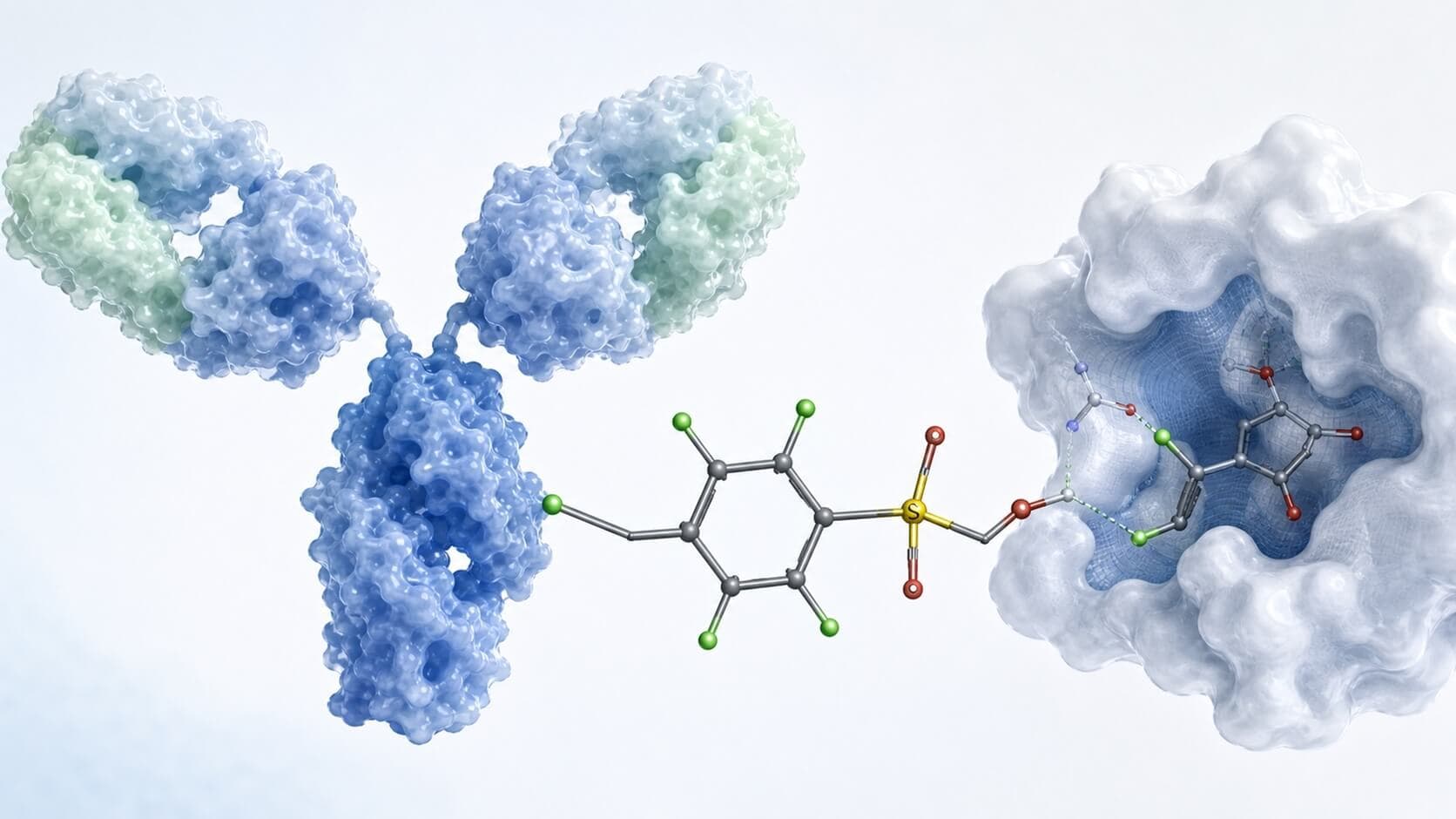
The reported 2,6-difluoroaryl sulfate linker targets sulfatase enzymes. Fluorine substitution on the aryl ring is described as tuning the electronic environment to accelerate enzymatic cleavage beyond the rate observed for unsubstituted or nitro-substituted aryl sulfates.
For an ADC design team, that makes the linker more than a swap of one leaving group for another. It changes the release hypothesis that must be tested: enzyme abundance, intracellular localization, competing hydrolysis, and payload release timing all become part of the same developability question.
How the reported fluorinated sulfate linker is designed
The 2,6-difluoro substitution pattern serves two purposes: increasing the electrophilicity of the sulfate ester toward enzymatic attack, and providing steric and electronic differentiation from competing aryl sulfate substrates.
The linker releases its payload through sulfatase cleavage followed by self-immolation, analogous to the PAB spacer mechanism but triggered by a different enzyme class. The cleavage rate is described as exceeding that of the classic nitro-based linker — a comparison relevant because nitro-PAB represents the most validated self-immolative linker architecture.
The work is attributed to researchers at the Technical University of Denmark and ADCendo (Chemical Communications, 2026).
The practical chemistry issue is balance. Aryl sulfate activation must be strong enough for enzymatic turnover but not so strong that the linker becomes chemically fragile during conjugation, storage, or circulation. Fluorinated building-block selection, impurity control, and hydrolysis testing therefore become linked development tasks rather than isolated structure-activity experiments.
Design considerations for sulfatase-targeted linkers
A new enzymatic trigger introduces development questions:
- Sulfatase expression across tumor types and normal tissues must be characterized — off-target cleavage could release payload systemically
- The linker must resist extracellular sulfatases while remaining susceptible to intracellular isoforms
- Fluorine substitution patterns should optimize cleavage rate without introducing metabolic liabilities
- Analytical methods must distinguish enzymatic cleavage from chemical hydrolysis of the sulfate ester
Implications for linker chemistry development
The reported work is useful as an enzyme-trigger expansion example. It describes how electronic tuning through fluorine substitution can make an aryl sulfate function as an enzyme-cleavable substrate - a design principle that may be relevant to other enzyme classes.
For linker development programs, the practical question is whether sulfatase cleavage offers therapeutic differentiation from cathepsin B, or provides an additional tool for specific indications. The answer depends on comparative tissue distribution data not provided in the chemistry-focused account.
That evidence boundary is important. The paper can inform linker design and enzyme-trigger screening, but it does not by itself establish a preferred clinical linker class. Translation would require antibody-specific internalization data, tumor and normal-tissue sulfatase profiling, payload-specific stability testing, and side-by-side comparison against established release chemistries.
FAQ
Why replace cathepsin B as the ADC linker trigger?
Cathepsin B-dependent linkers work well in many settings, but tumors with low enzyme expression may show reduced payload release. Alternative triggers broaden the design space.
How does fluorine substitution improve sulfatase cleavage?
The reported 2,6-difluoro pattern increases the electrophilicity of the sulfate ester, making it a better substrate for enzymatic attack.
Is this linker in clinical development?
The reported work describes linker chemistry and in vitro characterization. No clinical-stage claims are supported.