
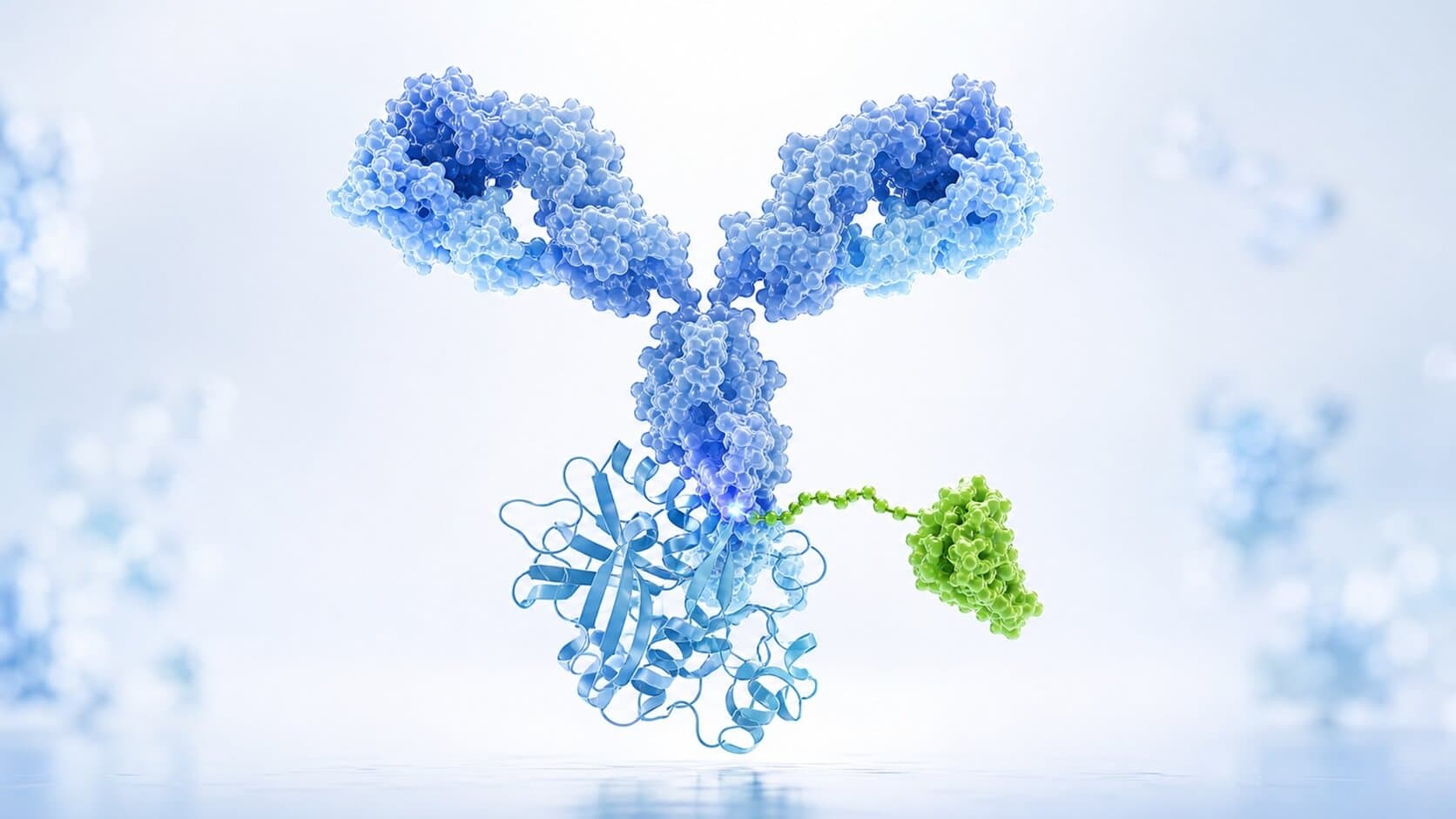
Why site-specific enzymatic conjugation matters for ADC design
Traditional ADC conjugation through reduced interchain cysteines or surface lysines produces heterogeneous mixtures. Each batch contains species with different drug-to-antibody ratios, different attachment sites, and potentially different pharmacokinetic profiles. Site-specific enzymatic methods aim to place the payload at a single, defined position on every antibody molecule.
The reported ligase-directed conjugation platform uses Sortase A, a bacterial transpeptidase, to catalyze site-specific attachment. An open-ring linker design is described as contributing to improved preclinical tolerability compared with matched stochastic conjugates. The Nature Communications paper presents this as a platform capable of generating ADCs with different payloads while maintaining conjugation site control.
For development teams, the important distinction is between payload potency and conjugation architecture. If the payload class stays comparable while attachment chemistry changes, any shift in exposure, stability, or preclinical tolerability can be investigated as a conjugation-site and linker-design question rather than only as a warhead question.
How the reported ligase-directed conjugation platform works
Sortase A recognizes a specific peptide motif and catalyzes a transpeptidation reaction that links the payload-bearing substrate to the antibody. According to the description, the open-ring linker chemistry is designed to release the payload selectively once the ADC reaches its target.
The platform is described as producing GQ1001, an ADC carrying the microtubule inhibitor DM1, and GQ1005, carrying the topoisomerase I inhibitor DXd. These two payloads correspond to familiar HER2 ADC payload classes, making the substitution a useful test of conjugation-site effects independent of payload class.
The Nature Communications paper reports lower preclinical toxicity in non-human primate studies compared with corresponding stochastic conjugates and maintained activity against drug-resistant models. These remain preclinical reported outcomes, not clinical, regulatory, or product-status conclusions.
Process implications for ADC development teams
Enzymatic conjugation introduces different process-control requirements than chemical methods:
- Enzyme activity, specificity, and residual levels must be characterized and controlled
- The peptide recognition motif must be accessible on the antibody without disrupting structure or function
- The linker chemistry must remain stable through the enzymatic step while still enabling payload release at the target
- Purification must separate the desired singly conjugated species from unconjugated antibody and any enzyme-related impurities
The reported combination of Sortase A with open-ring linker chemistry also raises a formulation question: whether the open-ring form is the intended circulating species or requires ring-closing before administration.
A robust development package would also need method coverage for site occupancy, drug-to-antibody ratio, free payload, residual enzyme, linker-related degradants, and positional isomers. Those controls are central because the value proposition of site-specific conjugation depends on proving that the intended conjugate is actually the dominant material after reaction, purification, storage, and stress testing.
Implications for site-specific conjugation development
The described work is most useful as a platform-architecture example. It illustrates how an enzymatic step can replace statistical chemical conjugation, and how linker design can be decoupled from conjugation-site chemistry. Development teams evaluating similar approaches would need to examine enzyme supply, conjugation efficiency at relevant scales, linker stability in circulation, and analytical methods capable of confirming site occupancy.
No regulatory, efficacy, safety, or product-status conclusion follows from the reported conjugation account. Site-specific conjugation is one tool among many for controlling ADC properties.
The platform also shows why linker and conjugation decisions should be reviewed together. A site-specific handle can reduce heterogeneity, but the linker still determines stability, release mechanism, and payload exposure. Treating these as separate modules can miss the way enzymatic coupling conditions, linker structure, and downstream purification interact.
FAQ
What is Sortase A used for in ADC conjugation?
Sortase A is a bacterial enzyme that recognizes a specific peptide sequence and catalyzes site-specific attachment. In the reported platform, it is used to conjugate payload-linker substrates to a defined position on the antibody.
How does open-ring linker chemistry differ from traditional ADC linkers?
The described open-ring linker is designed to remain stable in circulation and release the payload through a selective cleavage mechanism. Specific structural details should still be checked against the primary paper before development decisions.
Does site-specific conjugation guarantee a better ADC?
It supports more uniform conjugation, which may translate into more predictable pharmacokinetics. The reported platform's specific safety and activity outcomes remain preclinical findings, not clinical conclusions.