
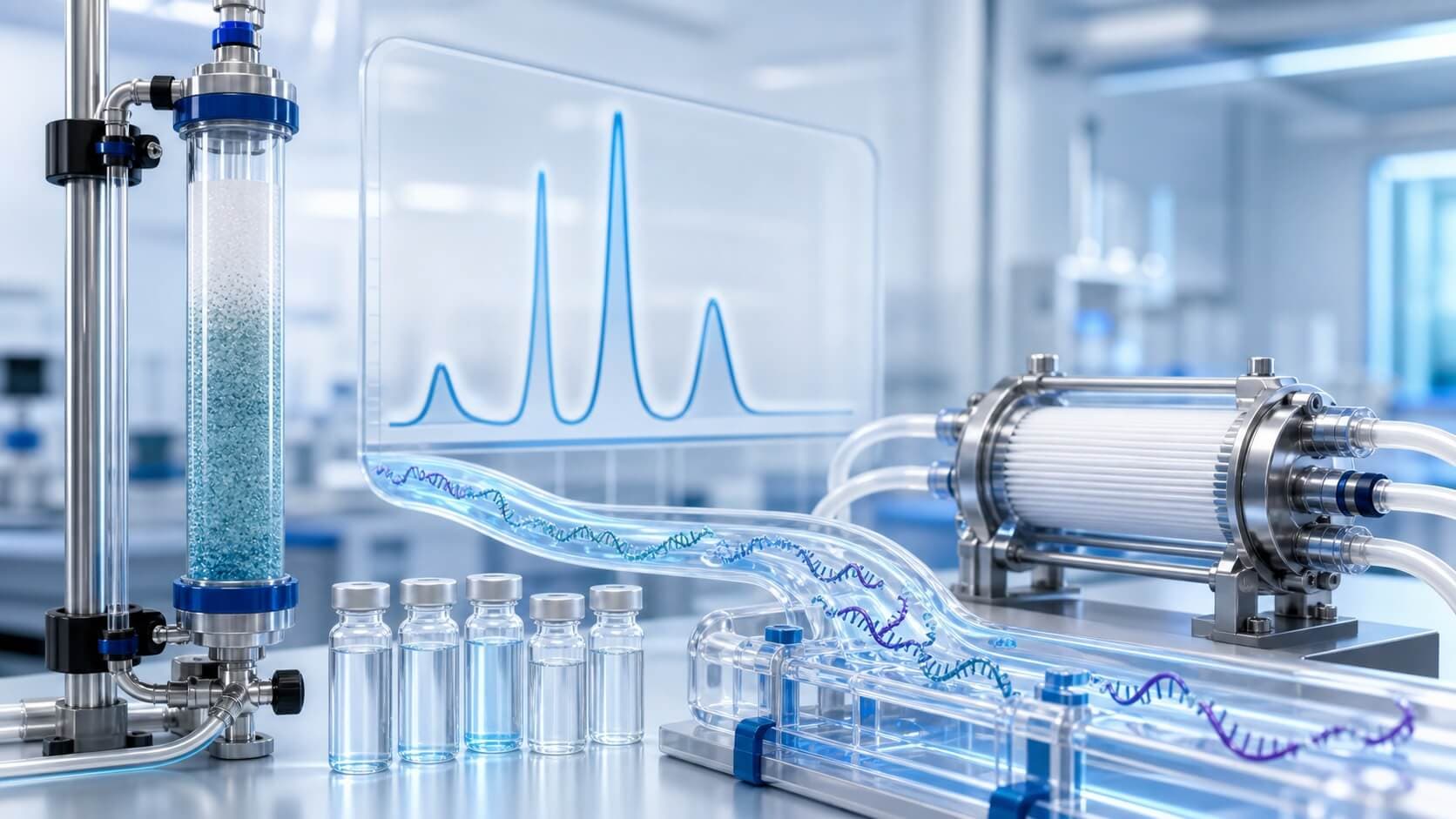
Why Oligonucleotide Purification Is Difficult
Oligonucleotide purification is difficult because the product and impurities are often very similar. A truncated sequence may differ from the target by one nucleotide. A phosphorothioate-related impurity may differ by a single oxygen-to-sulfur substitution. A deaminated product may differ by only one Dalton. These differences are small compared with the size and charge of the molecule.
In siRNA programs, purification is also connected to duplex formation. Two single strands must be made, purified and annealed correctly. The final material may contain residual sense strand, residual antisense strand, mismatched duplexes, aggregates or degradation products. A useful purification strategy must therefore account for both single-strand and duplex quality.
Major Impurity Classes After Synthesis
Common impurities include N-1 and shorter truncated sequences, N+1 extended sequences, depurination products, deamination products, oxidation products, capping-related byproducts, incomplete deprotection products and residual small molecules from synthesis.
For modified oligonucleotides, impurity patterns can be more complex. Modified monomers may produce unique failure sequences. Phosphorothioate linkages create diastereomeric complexity. Ligand conjugates such as GalNAc can produce incomplete conjugation products or linker-related impurities.
Purification should not be designed only around total purity. It should consider which impurities are most likely, which are hardest to remove and which may matter most for downstream use.
| Impurity type | Why it is difficult |
|---|---|
| N-1/N-2 truncated sequences | Very close charge and size to full-length product |
| N+1 extended sequences | May co-elute with target depending on method |
| Depurination products | Can fragment or create related species during workup |
| Deamination products | Small mass change; may need high-resolution MS |
| PS-related species | Diastereomeric complexity and PO/PS conversion issues |
| Ligand-related impurities | GalNAc or linker differences can change retention unpredictably |
Ion-Exchange Chromatography
Ion-exchange chromatography separates oligonucleotides mainly by charge and length. Since oligonucleotides are polyanionic, anion-exchange methods are widely used. Small differences in chain length can create retention differences, making IEX useful for separating full-length product from shorter species.
The method can be powerful, but it requires careful control of pH, salt gradient, temperature, resin selection and loading. Higher loading improves productivity but may reduce resolution. At preparative scale, peak broadening and reduced separation can become limiting.
IEX is often attractive for process-scale purification because it can handle charged biomolecules well and avoids some of the organic solvent burden of reverse-phase methods. However, high-salt buffers must be removed afterward, usually through desalting or TFF.
For development teams, IEX method development should not focus only on peak shape in the first analytical run. Loadability, gradient robustness, buffer preparation, salt removal and resin lifetime all matter if the method is expected to scale. A shallow gradient may improve resolution but increase cycle time and buffer volume. A higher load may improve productivity but reduce separation of N-1 impurities. These trade-offs should be documented rather than adjusted informally from batch to batch.
Reverse-Phase HPLC
Reverse-phase HPLC separates based on hydrophobic interactions, often using ion-pairing reagents for oligonucleotides. It can provide high resolution and is useful for separating impurities that differ in hydrophobicity, including certain modified or conjugated species.
For DMT-on purification, the hydrophobic DMT group can help distinguish full-length product from capped failure sequences. For final products, ion-pair reverse-phase methods may support both purification and analytical characterization.
The drawbacks are cost, solvent use, scalability and residual ion-pairing reagent concerns. Preparative RP-HPLC may be appropriate for high-value materials or difficult separations, but process economics must be considered.
RP-HPLC is especially useful when a conjugate or hydrophobic modification changes retention enough to separate target product from related impurities. For example, DMT-on purification can exploit hydrophobicity before final detritylation. GalNAc or lipid-conjugated oligonucleotides may also show separation behavior that differs from unconjugated strands. The same hydrophobicity that helps separation, however, can make recovery and method transfer more difficult.
TFF for Desalting and Concentration
Tangential flow filtration is commonly used for buffer exchange, desalting and concentration. It is not usually the main high-resolution purification step for separating N-1 impurities, but it is important in making a process practical.
TFF can remove salts, solvents and small molecules after chromatography. It can also concentrate the product to the desired level. Membrane selection, molecular weight cutoff, flux, pressure and concentration polarization must be controlled. For oligonucleotides, product loss to membranes and changes in concentration can affect yield.
Annealing for Double-Stranded siRNA
For double-stranded siRNA, purified sense and antisense strands are mixed at the appropriate ratio and annealed. Annealing conditions include buffer, temperature, heating profile, cooling rate and concentration. Poor annealing can leave residual single strands or generate mismatched duplexes.
Analytical confirmation should include methods that examine duplex integrity under non-denaturing conditions as well as single-strand purity under denaturing conditions. This dual view is important because a material can look acceptable by one method and problematic by another.
Purity, Yield and Cost Trade-Offs
Purification development is always a trade-off. Higher purity may reduce yield. Higher loading may improve productivity but reduce resolution. More purification steps may improve quality but increase cost, time and product loss.
For early research, speed and material availability may matter most. For process development, the process must become more robust and reproducible. For larger scale, solvent consumption, buffer volume, resin lifetime and waste treatment become important.
Analytical Confirmation After Purification
Purified oligonucleotides should be confirmed using orthogonal methods. HPLC provides purity information. LC-MS confirms mass and helps identify impurities. Capillary electrophoresis can provide complementary separation. UV supports concentration. For formulated or duplex materials, additional methods may be needed.
A good analytical package helps explain the material, not just release it. Understanding impurity identity and trends is essential for troubleshooting synthesis and purification.
How CHEMOS Supports Purification-Related Projects
CHEMOS can support custom synthesis and analytical development for oligonucleotide-related building blocks, linkers, conjugation intermediates and delivery-related materials. For customers working on downstream oligonucleotide programs, CHEMOS can help provide well-characterized inputs that reduce purification burden later.
FAQ
Which purification method is best for siRNA?
There is no single best method. IEX, RP-HPLC and TFF are often combined depending on impurity profile, scale and product requirements.
Why is N-1 difficult to remove?
N-1 impurities are close in size and charge to the full-length product, so high-resolution methods are needed.
Does TFF purify oligonucleotides?
TFF is mainly used for desalting, buffer exchange and concentration, not high-resolution separation of closely related sequences.
References and Further Reading
- Roberts TC, Langer R, Wood MJA. Advances in oligonucleotide drug delivery. Nature Reviews Drug Discovery, 2020. https://doi.org/10.1038/s41573-020-0075-7
- Gilar M, Fountain KJ, Budman Y, Neue UD, Yardley KR, Rainville PD, Russell RJ, Gebler JC. Ion-pair reversed-phase high-performance liquid chromatography analysis of oligonucleotides: retention prediction. Journal of Chromatography A, 2002, 958(1-2), 167-182.
- ICH Q11. Development and Manufacture of Drug Substances. https://www.ich.org/page/quality-guidelines
- ICH Q3A(R2). Impurities in New Drug Substances. https://www.ich.org/page/quality-guidelines
- ICH Q3C(R8). Impurities: Guideline for Residual Solvents. https://www.ich.org/page/quality-guidelines