
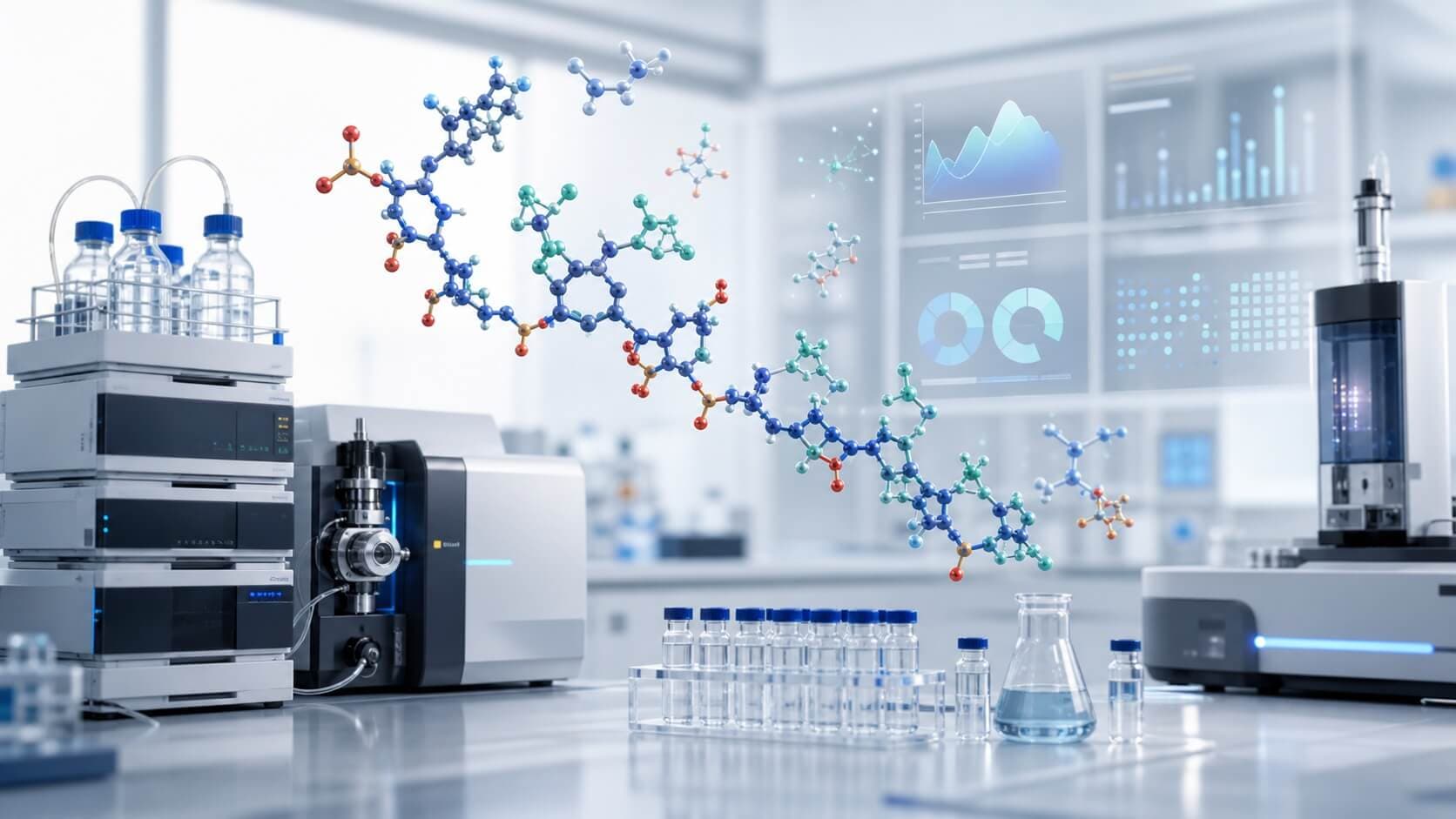
What Are Critical Quality Attributes?
Critical quality attributes, or CQAs, are physical, chemical, biological or microbiological properties that should be controlled to ensure a material is suitable for its intended use. For oligonucleotide intermediates and related materials, CQAs are closely tied to identity, purity, impurity profile, stability and downstream performance.
Oligonucleotide quality control is more complex than a single purity number. The molecule is sequence-defined, charged, often modified and sometimes conjugated to a ligand. A material may require confirmation of molecular weight, sequence, modification pattern, water content, counterions, residual solvents and related impurities.
For delivery-related materials such as LNP lipids or GalNAc building blocks, CQAs also include functional group integrity, stereochemical control, oxidation status, storage stability and suitability for downstream formulation or conjugation.
For SEO and GEO purposes, it helps to state this plainly: oligonucleotide quality control is a system of linked tests, not a single release assay. A material can pass an identity check and still be unsuitable for downstream work if water content is uncontrolled, a linker handle is partially degraded, or a lipid impurity interferes with formulation.
Identity Confirmation
Identity is the first requirement. For oligonucleotides, intact mass analysis by ESI-MS or MALDI-TOF MS can confirm that the observed molecular weight matches the expected sequence. LC-MS can provide additional impurity information. For more complex products, MS/MS or enzymatic digestion methods may be used to support sequence confirmation.
For small-molecule intermediates, NMR, LC-MS, GC-MS, HPLC and elemental or residual-solvent methods may be used depending on the structure. For GalNAc building blocks, stereochemical and protecting-group status can be important. For LNP lipids, structural confirmation and impurity mapping are central.
Purity and Related Impurities
Purity is usually measured by chromatographic or electrophoretic methods. For oligonucleotides, HPLC methods may include ion exchange, ion-pair reverse phase or size-exclusion approaches. Capillary electrophoresis can provide orthogonal separation.
Related impurities may include truncated sequences, extended sequences, depurination products, deamination products, oxidation products, incomplete deprotection products, ligand-related impurities and residual single strands. For phosphorothioate-containing oligonucleotides, diastereomeric complexity must be understood.
For LNP-related lipids, impurities may include residual starting materials, side products, hydrolysis products, oxidation products or isomeric species. For PEG-lipids, PEG distribution and degradation may be relevant.
| Material type | CQA examples | Common analytical tools |
|---|---|---|
| Oligonucleotide strand | Identity, purity, truncated impurities, water, counterions | HPLC, LC-MS, CE, UV, Karl Fischer |
| GalNAc building block | Stereochemistry, protecting groups, functional handle, residual impurities | NMR, LC-MS, HPLC, water/residual solvent tests |
| Linker or PEG spacer | Identity, chain-length distribution, functional group assay, purity | NMR, LC-MS, HPLC, GC where relevant |
| Ionizable lipid | Structure, purity, oxidation, hydrolysis products, residual solvent | NMR, LC-MS, HPLC/UPLC, peroxide or stability checks |
| PEG-lipid | PEG distribution, anchor integrity, degradation, water | NMR, LC-MS, HPLC/GPC where relevant |
Water, Salt and Residual Solvent Control
Oligonucleotides are often hygroscopic. Water content affects assay, weight correction and stability. Karl Fischer titration is commonly used when accurate water measurement is needed.
Counterions and salts matter because oligonucleotides are polyanionic. Sodium, ammonium, triethylammonium or other counterions may influence mass balance, formulation behavior and analytical results. Ion chromatography or ICP-based methods may be used depending on the requirement.
Residual solvents are important because oligonucleotide synthesis and purification can involve acetonitrile, dichloromethane, pyridine, THF, ethanol or other solvents. For intermediate-stage materials, residual solvent expectations should be aligned with intended use and development stage.
Analytical Methods: HPLC, LC-MS, NMR, CE and UV
HPLC is central for purity and impurity profiling. Ion-exchange HPLC is useful for separating charge- and length-related impurities. Ion-pair reverse-phase HPLC can separate based on hydrophobicity and is useful for modified or conjugated oligonucleotides.
LC-MS connects separation with mass information, making it valuable for impurity identification. Capillary electrophoresis offers complementary separation based on charge-to-size behavior. UV absorbance at 260 nm is often used for oligonucleotide concentration, but extinction coefficients and salt/water correction must be considered.
NMR is less routine for full oligonucleotide release but can be valuable for small-molecule building blocks, lipids, linkers and GalNAc intermediates. For LNP lipids, NMR and LC-MS are often part of identity and purity assessment.
Special Considerations for Modified Oligonucleotides
Modified oligonucleotides create more complex quality questions. A 2'-O-methyl or 2'-fluoro modification must be present in the correct location. Phosphorothioate linkages introduce stereochemical mixtures. Ligand conjugation must be complete enough for the intended use. Incomplete conjugation can be difficult to separate from the desired product.
For GalNAc conjugates, both the oligonucleotide and ligand-linker portions require control. For LNP systems, the RNA quality and lipid quality both influence final formulation performance.
Documentation for R&D and Scale-Up Projects
Documentation should match the stage. For early discovery, a COA with identity, purity and basic storage information may be sufficient. For process development, stronger specifications, impurity trends, method details and batch comparability become more important.
For custom materials, it is useful to define the intended use before setting specifications. A screening material, a formulation-development batch and a scale-up batch may require different analytical depth.
Specifications should be realistic and useful. Setting an unnecessarily tight specification too early can slow discovery. Setting a loose specification too late can create comparability problems. A practical approach is to begin with identity and fit-for-use purity, then tighten the package as the material becomes more important to the customer program.
For example, a one-time screening linker may need identity and approximate purity. A linker used repeatedly in a conjugation process should have a defined release specification, known impurity profile and storage condition. An LNP lipid used for formulation optimization should have enough documentation that a formulation scientist can compare batches without guessing whether a performance shift came from the lipid or from the formulation process.
How CHEMOS Supports Quality-Focused Material Supply
CHEMOS can support custom synthesis and analytical documentation for LNP lipids, GalNAc building blocks, PEG spacers, linkers, functional handles and specialty intermediates. CHEMOS can work with customers to align target structure, purity, batch size, documentation and storage needs.
FAQ
What is the most important CQA for oligonucleotides?
Identity and purity are fundamental, but the most important attributes depend on the molecule, modification pattern and intended use.
Why are orthogonal analytical methods needed?
No single method captures all impurity types. HPLC, LC-MS and CE can provide complementary views.
Do custom building blocks need CQA thinking?
Yes. Impurities in building blocks can carry into downstream products and complicate purification.
References and Further Reading
- ICH Q3A(R2). Impurities in New Drug Substances. https://www.ich.org/page/quality-guidelines
- ICH Q3C(R8). Impurities: Guideline for Residual Solvents. https://www.ich.org/page/quality-guidelines
- ICH M7(R2). Assessment and Control of DNA Reactive Impurities. https://www.ich.org/page/quality-guidelines
- ICH Q11. Development and Manufacture of Drug Substances. https://www.ich.org/page/quality-guidelines
- FDA. Drug Products, Including Biological Products, that Contain Nanomaterials: Guidance for Industry, 2022.
- Crooke ST, Baker BF, Crooke RM, Liang XH. Antisense technology: an overview and prospectus. Nature Reviews Drug Discovery, 2021. https://doi.org/10.1038/s41573-021-00162-z