
Why the reported cortinarin route matters for peptide process design
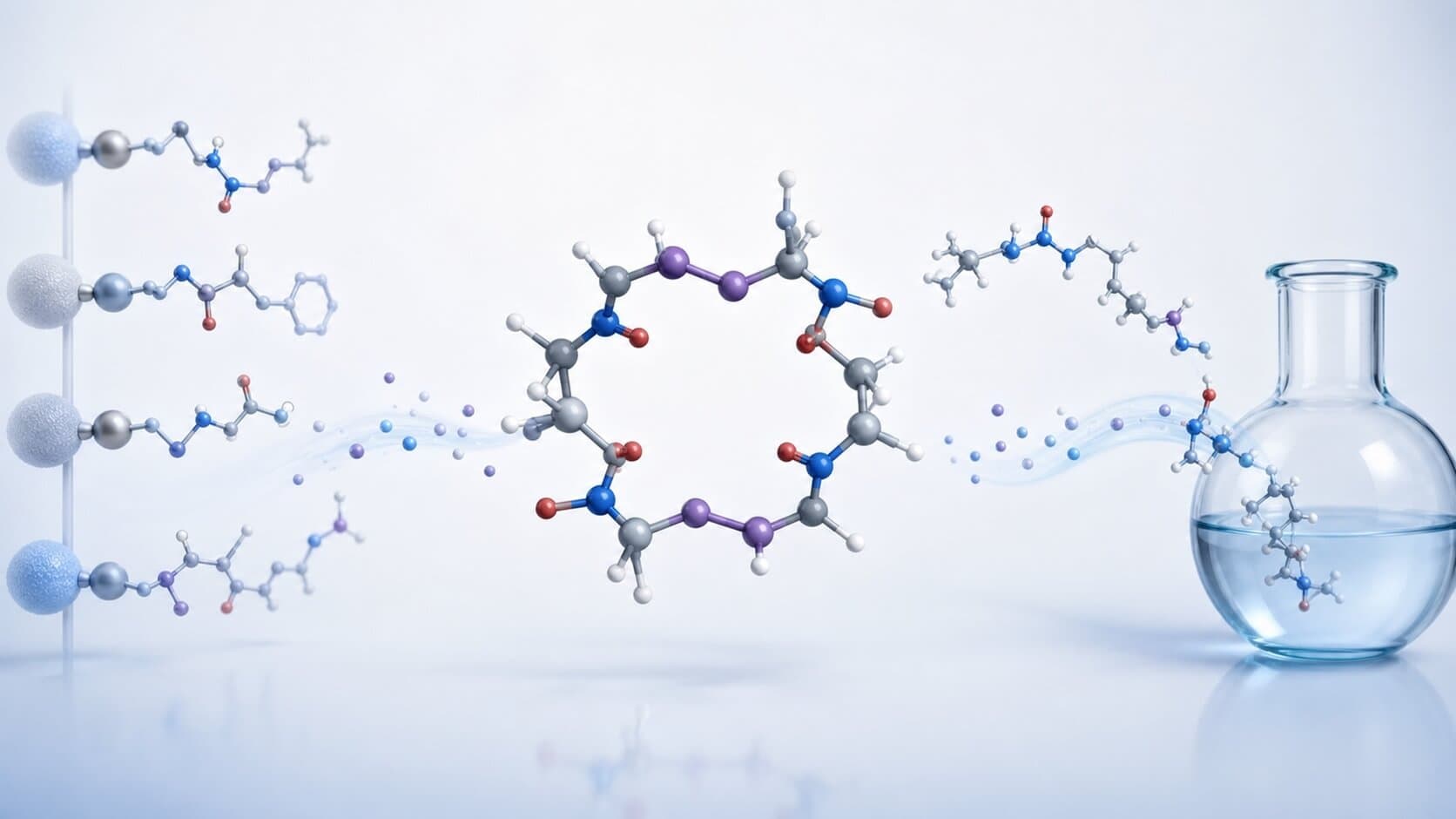
The reported route divides a difficult bicyclic peptide target between solid-phase peptide assembly and solution-phase cyclization. That division gives peptide development teams a concrete framework for deciding which transformations belong on resin and which require solution-phase control. The primary Chemical Science paper supports the synthesis-and-characterization framing used here; this article does not rely on an unverified priority claim.
A constrained target with limited natural access
Cortinarins are described as ten-residue bicyclic peptides derived from Cortinarius mushrooms. Their natural abundance is reported to be extremely low, while structural instability has restricted systematic bioactivity research. Synthetic access is therefore first a materials and characterization problem: researchers need reproducible samples before they can investigate the molecules in a controlled way.
The synthesis account is attributed to researchers including Zhanyu He, Celine Janssen, Joana-Lysiane Schafer, Agnes Muhlenweg, and Simone Kosol. It identifies a hybrid route built around solid-phase peptide synthesis and a later solution-phase cyclization. The available description supports that route-level outline, not a complete process-transfer package.
Hybrid phase planning separates different process constraints
Solid-phase peptide synthesis is well suited to iterative chain extension because excess reagents and soluble by-products can be removed between cycles. A subsequent solution-phase closure moves the macrocyclization into an environment where concentration, mixing, solubility, and reaction time can be adjusted directly.
That split does not remove route risk; it changes where the risk appears. A process team evaluating a similar bicyclic peptide would need to examine:
- whether each building block and protecting group tolerates the full assembly sequence;
- whether the resin-bound intermediate remains accessible during the planned bridge-forming operation;
- how cleavage conditions affect the protected peptide before macrocyclization;
- how concentration and addition strategy influence intramolecular closure versus intermolecular by-products; and
- whether purification can distinguish the intended topology from closely related impurities.
These are development questions prompted by the reported route architecture. They are not disclosed operating conditions or claims of a validated manufacturing process.
Bicyclic construction raises an analytical question as well as a synthetic one
The account identifies bridge formation and construction of the bicyclic scaffold as central challenges. For a constrained peptide, confirming molecular mass alone may not establish that both closures have the intended connectivity. A fit-for-purpose analytical plan may therefore need chromatographic purity testing plus orthogonal structural evidence chosen for the specific scaffold.
This consideration affects route scouting early. If a bridge-forming step creates isomers or alternative connectivities, the team needs methods capable of detecting them before investing in optimization. Reference-material strategy, intermediate hold times, and sample handling should also be assessed when the target is structurally unstable.
Practical implications for cyclic-peptide R&D teams
The reported cortinarin synthesis is most useful as a route-design example. It illustrates how a complex peptide program can allocate iterative assembly to a solid support while reserving a ring-closing event for solution. For project planning, the important questions are whether that division improves control, whether the isolated intermediates are manageable, and whether the analytical package can verify the intended bicyclic structure.
No biological efficacy, safety, therapeutic, regulatory, or product-status conclusion follows from the synthesis description. Greater synthetic access can enable later research, but it does not establish biological performance.
FAQ
What are cortinarins?
Cortinarins are described as a class of bicyclic decapeptides originating from Cortinarius mushrooms. Reports characterize their natural abundance as very low and their structures as unstable.
What synthesis strategy was reported?
The route-level description combines solid-phase peptide synthesis with solution-phase cyclization to construct the bicyclic peptide framework. Detailed operating conditions are outside the independently confirmed evidence available for this article.
Why combine solid-phase and solution-phase operations?
The hybrid format lets route designers assign iterative peptide-chain assembly to a resin-supported workflow and evaluate a later cyclization under solution-phase controls. Its suitability still depends on the sequence, protecting-group scheme, intermediate behavior, and impurity profile.
Does the synthesis report establish biological activity or product status?
No. The primary paper reports synthesis and characterization of cortinarins. Any biological efficacy, safety, therapeutic, regulatory, or product-status conclusion remains outside the evidence boundary.