
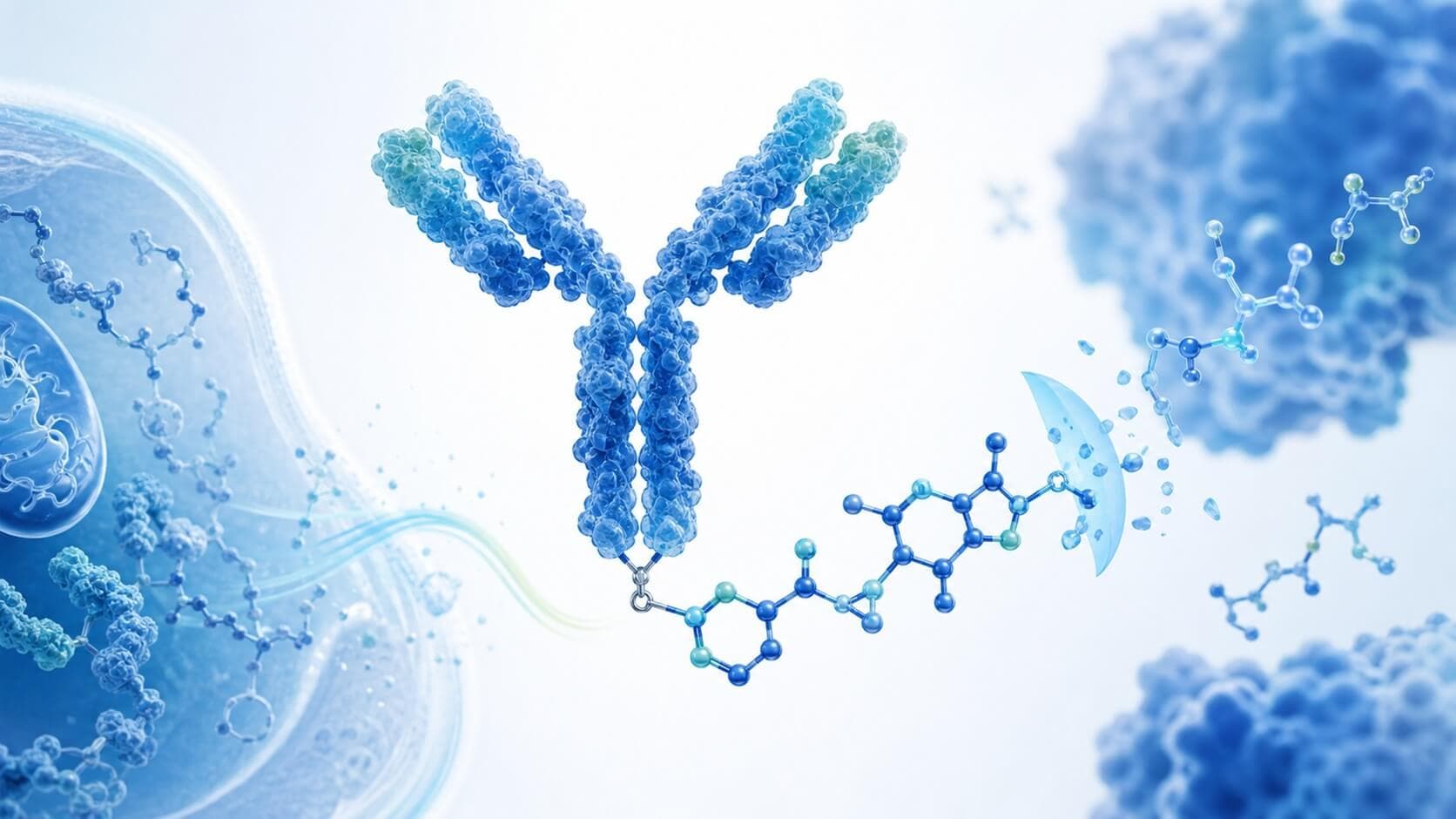
The Primary Paper Supports A Preclinical Payload-Design Case Study
The paper title, "GD2-directed NAMPT inhibition using antibody-drug conjugates in neuroblastoma," supports a narrow evidence boundary: this is a reported preclinical ADC design built around GD2 targeting and NAMPT inhibition. It should not be presented as a clinical-stage therapy, a regulatory-stage asset, or proof that metabolic payloads broadly outperform established ADC payload classes.
That boundary matters because secondary write-ups can include strong biological claims about tumor selectivity, normal-cell sparing, in vivo tumor inhibition, and novelty of the payload class. Those may be useful leads for technical review, but a publishable CHEMOS article should treat the work as a design case study unless the exact outcome details are independently checked against the primary paper.
NAMPT Changes The Payload Question
NAMPT is the rate-limiting enzyme in the NAD salvage pathway. A NAMPT inhibitor payload therefore raises a different set of ADC design questions from microtubule inhibitors or DNA-damaging payloads. Instead of relying only on acute cytotoxicity, the design logic depends on intracellular delivery, enzyme inhibition, NAD pathway disruption, and the exposure time required for a metabolic effect.
For payload chemists, that creates several implications. The inhibitor needs a conjugation point that preserves the relevant binding and inhibitory properties. The linker must release an active species under intracellular conditions. The released payload and any linker-derived metabolites need to be distinguishable analytically. Potency, permeability, intracellular retention, and metabolic rescue experiments become part of the same interpretation package.
GD2 Targeting Adds A Second Development Boundary
The reported construct uses a GD2-directed antibody context for neuroblastoma modeling. GD2 targeting is relevant because it can create an antibody-mediated delivery route into a tumor setting where the antigen is biologically meaningful. However, antigen expression alone does not settle ADC developability. Internalization, trafficking, linker cleavage, payload release, and normal-tissue exposure all have to be assessed together.
That is why the article should avoid turning the reported preclinical model into a broad selectivity claim. A safer formulation is that the paper explores whether GD2-directed delivery can localize a NAMPT-inhibitor payload in a neuroblastoma model. Any statement about safety, clinical tolerability, or patient benefit would require additional official or clinical evidence not present in this package.
Linker And Analytical Work Become Central
The reported design includes a cleavable linker strategy and a modified NAMPT inhibitor payload. That is the most CHEMOS-relevant layer. If a small-molecule inhibitor is converted into an ADC payload, the synthetic route must introduce a handle without destroying the desired biological activity. The linker-payload intermediate must also remain compatible with antibody conjugation, purification, storage, and release testing.
Analytical design would need to cover intact ADC, drug-to-antibody ratio, aggregation, unconjugated antibody, free inhibitor, linker-related degradants, and the released payload form. Because a metabolic inhibitor may have a different potency and exposure profile from a classic ADC cytotoxin, the assay package should be built to separate conjugation performance from payload-mechanism interpretation.
What This Means For ADC Payload Programs
The reported NAMPT-inhibitor ADC is best used as a prompt to widen payload-design thinking. It suggests that metabolic enzyme inhibitors may be considered as ADC payload candidates when the target biology, linker design, and release mechanism can be evaluated together. It does not remove the need for careful pharmacology, safety, or translational review.
For development teams, the practical question is whether the linker-payload chemistry can support a clean test of the mechanism. If the conjugation handle weakens the inhibitor, if release produces a poorly characterized metabolite, or if the ADC mixture is heterogeneous, the biology will be hard to interpret. Chemistry quality is therefore not a downstream detail; it determines whether the payload hypothesis can be tested.
FAQ
What is NAMPT?
NAMPT is nicotinamide phosphoribosyltransferase, an enzyme involved in NAD biosynthesis through the salvage pathway. Inhibiting NAMPT is a metabolic intervention, not a conventional ADC microtubule or DNA-damaging payload mechanism.
Why use GD2 in this ADC design?
GD2 provides an antibody-targeting context for the reported neuroblastoma model. The article treats it as a preclinical delivery strategy, not as proof of clinical selectivity.
Is this ADC in clinical development?
No clinical-stage or regulatory-status claim is supported by the current package. The article should be read as a reported chemistry and preclinical payload-design case study.